
Words by Mathias Nicola · August 2026 · Revised October 2026
There are cities that produce greatness quietly, without announcement or ceremony, and Salto is one of them. Footballers, writers, poets. But there is another story, less often told outside the country, that connects this city on the Uruguay River to the heart of tango: the story of Irineo Leguisamo, the greatest jockey in the history of South American horse racing, and his friendship with Carlos Gardel, the man who gave tango to the world.
Irineo Leguisamo was born in Salto on 14 February 1903. He grew up far from the racetracks of Buenos Aires, in a modest family in the Uruguayan interior, the kind of upbringing that breeds either resignation or fierce ambition. Leguisamo chose the latter. He crossed the Uruguay River as a young man and in Buenos Aires became, quite simply, the most celebrated jockey of his era. In a career spanning five decades he won more than 3,500 races. He was elegant in the saddle the way great artists are elegant: effortlessly, as though any other way of doing it would be wrong.
It was in Buenos Aires that Leguisamo met Carlos Gardel. Where exactly Gardel was born has never been settled: some place his birth in Tacuarembó, Uruguay, others insist on Toulouse, France, and the debate is old and genuinely open. What is beyond dispute is that Gardel’s voice, his style and his genius belong to the Río de la Plata in the fullest sense: to both banks of the river, to a shared culture that was never the property of one country. And one of those banks is Salto’s.
The two men were drawn together by temperament as much as by circumstance: both self-made, both magnetic, both adored with a devotion that bordered on the religious. Gardel shared with Leguisamo a passion for horse racing almost as intense as his love of singing. They bet on horses together, laughed together and were photographed together so often that in Buenos Aires their names became almost inseparable. Their friendship was the kind that only the River Plate seems to produce: warm, loud, deeply loyal and entirely without pretension.
So deep was his admiration for the jockey from Salto that Gardel recorded a tango written in his honour. Leguisamo Solo, composed by Gardel himself with lyrics by Guillermo Barbieri, is a declaration of affection as much as a tribute: joyful, rhythmic, full of the energy of the racetrack and the friendship of two men at the peak of their powers. It remains one of the most personal songs in the Gardel catalogue.
“Leguisamo solo, solo en la pista,
nadie le gana, nadie le pisa,
el potro vuela bajo su mano
como si el viento fuera su hermano.”
Carlos Gardel, Leguisamo Solo
Gardel visited Salto. The exact date is not carved into the record with the precision of a battle or a treaty, but the memory of his visit is, preserved in the oral tradition of the city, in family stories passed from grandparent to grandchild, and in the pride with which people here speak of the night the greatest voice in the history of tango walked their streets. He stayed at the Hotel Concordia, then as now one of the finest addresses in the Uruguayan interior. It is said that he sang informally that evening: not a concert, not a performance, but the private, spontaneous music that only happens when a great artist is among friends and entirely at ease.
Tango was born in the working-class suburbs of Buenos Aires and Montevideo in the late 19th century, the music of immigrants and the dispossessed: Italian, Spanish, African and indigenous voices fused into something wholly new, wholly River Plate. Gardel did not invent tango, but he gave it the voice it needed to cross the Atlantic. When he died in a plane crash in Medellín in 1935, at the age of 44, the whole Spanish-speaking world went into mourning. In Buenos Aires they still say “Cada día canta mejor”: each day he sings better.
Today, on the high riverfront of Salto, there is a place where both men are honoured together. The Plazoleta Los Inmortales, the little square of the immortals, sits at the edge of the Uruguay River, and from its terrace the light of the setting sun pours across the water. Here two murals face the river. On one wall is the face of Gardel: the unmistakable gaze, the hat tilted just so, the composed expression of a man who carried the weight of legend without effort. On the other, Leguisamo as only he can be shown: mounted, in full flight, horse and rider one line of speed. It is not a grand monument in the classical sense. It is something more immediate, two images on two walls, facing the same river, in the same light.
The Plazoleta Los Inmortales offers something rare: not the polished tourism of a capital, but a quiet, unguarded meeting with great history. There are no crowds and no queues. There is a terrace, a wall of faces, and the weight of what these two men meant, and still mean, to the culture of the Río de la Plata.
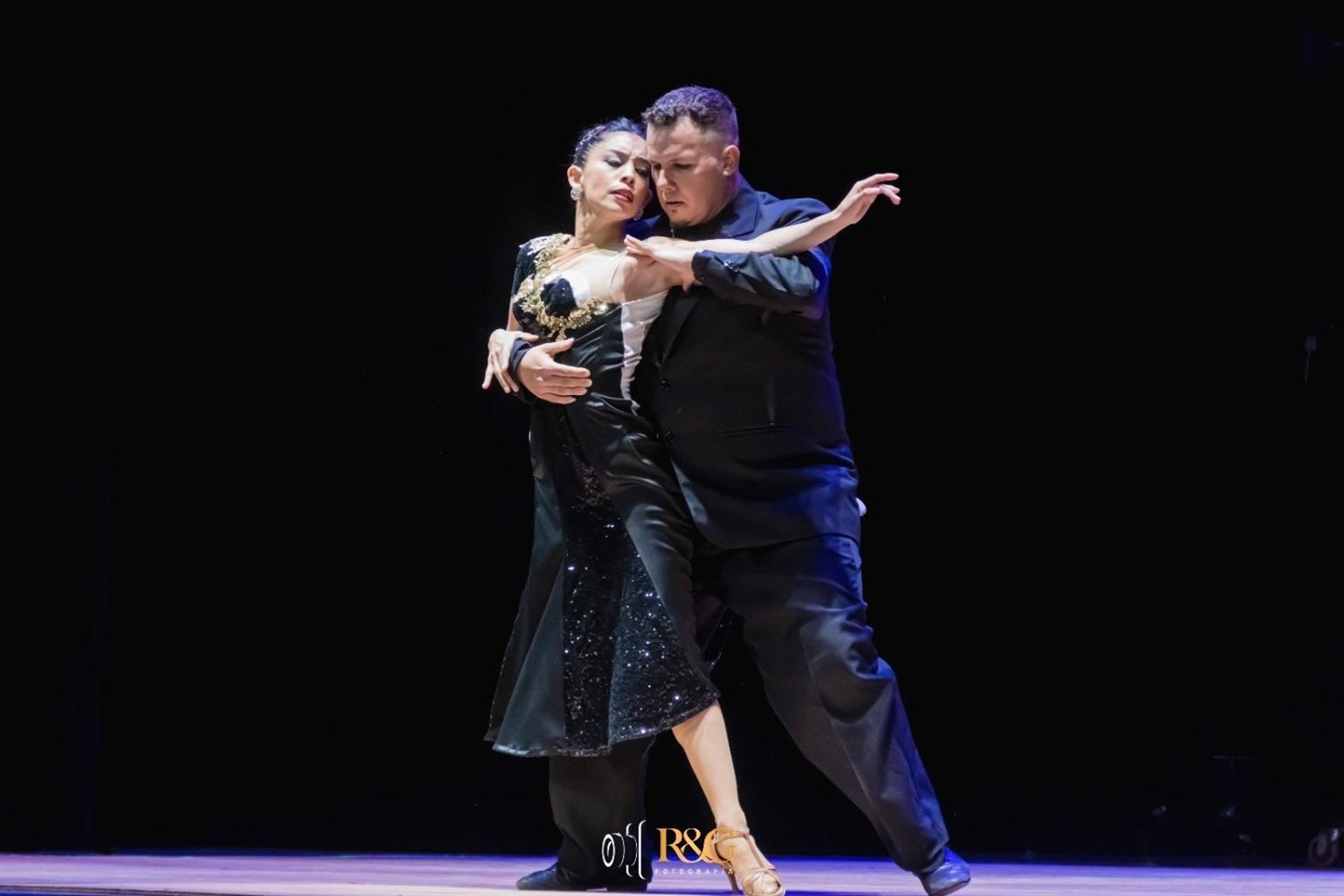
Salto has tango musicians and dance teachers who take the tradition seriously, and a class is there if the plazoleta leaves you wanting one. There are also venues where a singer performs live. Tango is not a performance you watch from a distance. It is something that happens to you.
The river will still be golden when you leave. The faces on the wall will still be there. And somewhere, in the phrasing of a note or the turn of a step, Gardel will still be singing better than the day before.