
Words by Mathias Nicola · August 2026 · Revised October 2026
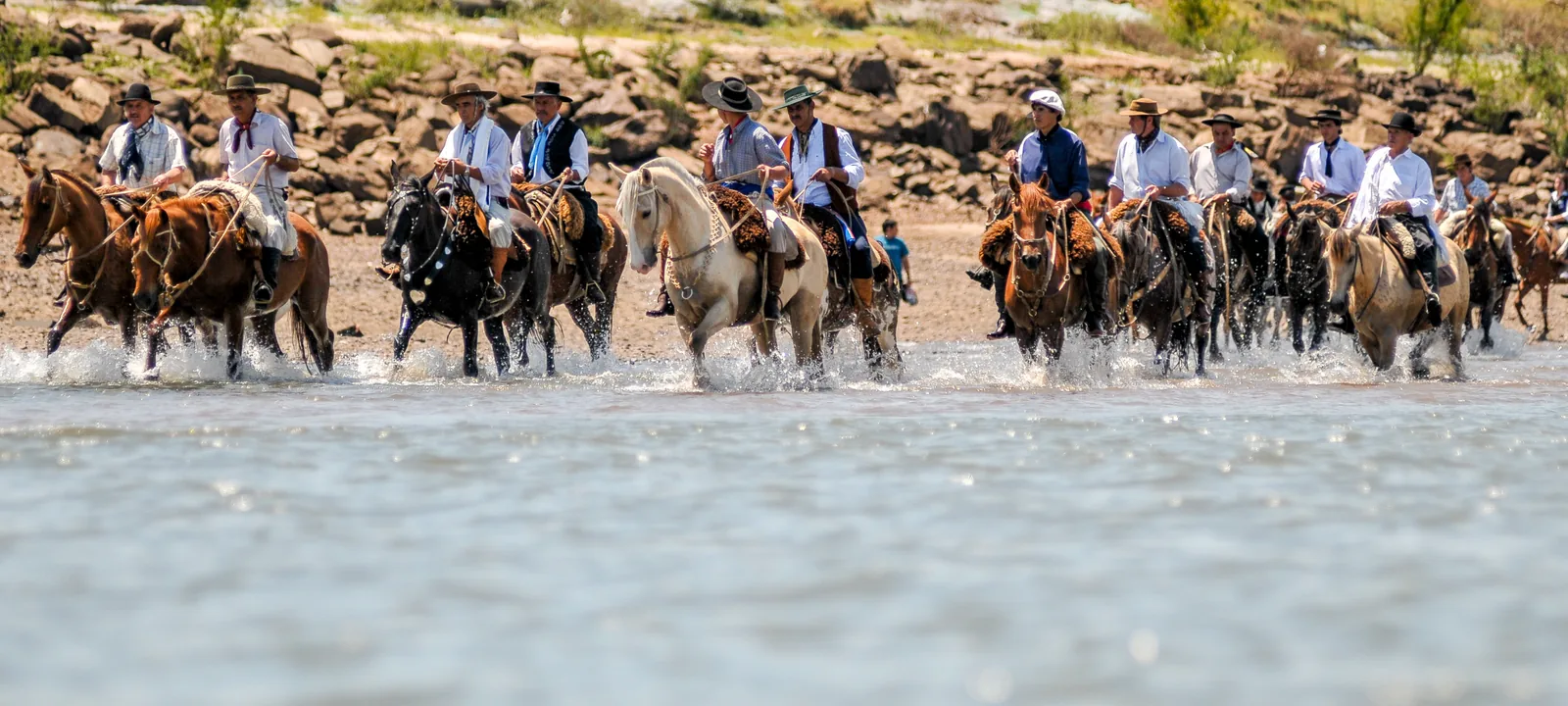
Before Giuseppe Garibaldi became one of the makers of modern Italy, before the red shirts, the Thousand and the march on Naples, he fought a battle on the northern edge of Salto that made his name on two continents. It took place on 8 February 1846 beside the Arroyo San Antonio, in the sweltering heat of a Uruguayan summer, and it lasted from midday to midnight.
An exile with a death sentence
Garibaldi was born in Nice on 4 July 1807 and went to sea as a boy. In 1834, caught up in one of Mazzini's failed uprisings, he fled Piedmont and was sentenced to death in his absence by a court in Genoa. In January 1836, aged 28, he landed in Rio de Janeiro: a merchant captain with revolutionary ideas and no money, and as yet no experience of war.
South America gave him both. He fought for the rebel republic of Rio Grande do Sul in Brazil, where in 1839 he met Anita, the woman who would ride and fight beside him for the next 10 years. By 1841 he was in Montevideo. Uruguay was sliding into the Guerra Grande, the long civil war between the Colorado government of the Defensa, holed up in a besieged Montevideo, and Manuel Oribe's Blancos, backed by Juan Manuel de Rosas in Buenos Aires. In 1843 Garibaldi raised the Italian Legion from the exiles of Montevideo, and it was there that his men first wore the red shirts that later became his emblem. Soon he also commanded the republic's small navy.
Salto, 1845
In 1845, sailing up the Uruguay River with the backing of the British and French squadrons, Garibaldi's flotilla took Colonia, the island of Martín García, Gualeguaychú and finally, in the last months of the year, Salto. He fortified the town, building a battery roughly where the Banco Hipotecario building stands today, and spent the summer holding it. Local gauchos and outlaws (matreros) joined him, among them the English-born caudillo José Mundell with 150 men. When Justo José de Urquiza arrived from Entre Ríos in December and laid siege, Garibaldi refused to yield. Urquiza, who was only passing through, gave up after 18 days. On 9 January 1846 Garibaldi broke the remaining besiegers in a night attack at Puntas del Arroyo Ceibal. He later wrote that the campaign on the Uruguay River was the most brilliant of his life.
8 February 1846
On 7 February a message arrived from General Anacleto Medina, a government commander marching down from the north with about 500 horsemen. He would reach the hills near Salto the next day and asked Garibaldi to cover his approach. On the morning of the 8th Garibaldi marched out to meet him with the four companies of the Italian Legion, fewer than 200 men, and a force of Uruguayan cavalry under Colonel Bernardino Báez. His second-in-command, Francesco Anzani, stayed behind in Salto with the sick and the handful of men guarding the battery.
They never reached Medina. Near the Arroyo San Antonio Chico, on the flat red ground north of the town, the column ran into the army of General Servando Gómez: Oribe's forces, with Argentine units attached, including the Patricios battalion of Buenos Aires under Colonel Cesáreo Domínguez. Garibaldi reckoned them at 1,200 men, around 300 of them infantry carried into the fight riding pillion behind the cavalry. Blanco accounts gave lower figures, but every source agrees the Legion was outnumbered many times over.
The first clash was between the two cavalries, and it went badly. Báez's horsemen broke within minutes and rode for Salto. Garibaldi, galloping back to the Legion, was thrown when his horse fell. He got up and fired a pistol in the air so his men could see he was unhurt. About 20 of the Uruguayan riders, ashamed of the rout, turned back and dismounted to fight alongside the Italians. The Legion took cover in the only shelter on the plain: the Tapera de Don Venancio, the ruins of an old hide-salting works, little more than a thatched roof on posts and some broken low walls near the stream.
Garibaldi told his men they were few against many, which would make the victory greater, and ordered them to hold their fire until the enemy was close and then use the bayonet. When Gómez's infantry advanced and fired at 60 paces, the Legion answered with a single volley that cut down the attacking column and killed its commander. Charge after charge followed through the afternoon, some reaching the walls and turning into hand-to-hand fighting. One rider tried to set the thatch alight. Garibaldi stopped his men from shooting him, saying men that brave deserved to live. A 15-year-old bugler known as “el Colorado” was lanced while sounding the calls and died after wounding his attacker. There was no water. Men chewed roots and sucked on musket balls, and the unhurt sang the Legion's hymns while the wounded joined the chorus.
The night march
As darkness fell the enemy pulled back to rest, convinced the Legion was finished, out of ammunition and dying of thirst. In fact the legionaries had stripped cartridges from the dead. Garibaldi formed a column with the wounded in the middle and the lightly wounded at the head, and in the dark slipped through the enemy lines towards the river. When the pursuing cavalry came on, the Legion waited in a wood, let them close to 50 paces and fired again. Then it marched along the wooded bank of the Uruguay River and reached Salto around midnight. Anzani, who had spent the day refusing demands to surrender the fort and threatening to blow up the magazine rather than give it up, met them at the gate in tears.
Garibaldi's own report, written the next day, gives the cost: 30 dead and 50 wounded out of fewer than 200, every officer hit, and just over 100 men unhurt. Only two wounded who could not be carried were left on the field. Enemy losses are disputed, as they always are. A later reconnaissance found two trenches of bodies, and Garibaldi claimed the enemy infantry had been destroyed. Gómez, for his part, reported a victory to Oribe from “the field of victory at San Antonio”.
Who won?
Both sides had a case. Gómez held the ground and, months later, after Garibaldi had sailed back to Montevideo, took Salto. But on 8 February fewer than 200 infantry had stood for 12 hours against a force several times their size, inflicted far heavier losses than they took, and marched home in order. Even Antonio Díaz, a historian hostile to Garibaldi, called it one of the most glorious actions of his American career.
The news reached besieged Montevideo two weeks later, on Carnival Sunday, by river. Florencio Varela's Comercio del Plata published the details the next morning, and on 24 February 1846 the government issued a decree. Garibaldi and his men had “deserved well of the fatherland”. The Legion's flag, black with a flaming Vesuvius, would carry the words “Hazaña del 8 de febrero de 1846” (the feat of 8 February 1846) in gold. The names of all who fought after the cavalry left would hang in the Casa de Gobierno, the seat of government, with the dead listed first. Their families would draw double pensions. Every man would wear a shield on his left arm reading “Invencibles combatieron el 8 de febrero de 1846” (invincibles fought on 8 February 1846). The Legion would hold the right of the line until another unit matched the feat.
When Garibaldi returned to Montevideo in September 1846 he was received as a national hero, a scene painted by Johann Moritz Rugendas. In 1847 the Defensa made him a general and, briefly, commander of all its forces.
From Salto to Italy
The story crossed the Atlantic. Mazzini and the exile press made San Antonio a legend in Italy and beyond, and when Garibaldi sailed from Montevideo on 15 April 1848 with Anzani and some 60 legionaries to join the revolutions sweeping Europe, he arrived in Nice in June as a soldier with a reputation already made. At San Antonio he had held his fire, closed with the bayonet and retreated only in order and only at night. Those were the tactics he brought to the defence of Rome in 1849 and to Sicily in 1860. The Risorgimento was built, in part, on a reputation earned beside a stream in Salto.
Garibaldi never forgot the town. He wrote of Salto that he would always remember it with deep gratitude. In 1876, a year after the Società Italiana di Salto was founded, he accepted the title of its perpetual honorary president, and his letter of thanks still hangs there. Several of his legionaries stayed in Salto and founded families whose names you will still find in the city.
Hero or mercenary?
A few years ago, in London, I got talking to a Roman about this story. His verdict was short: Garibaldi was a mercenary. It surprised me at the time, but it shouldn't have. In Italy, Garibaldi is both the most honoured and the most argued-over figure of the 19th century.
The official version is unambiguous. He is the Eroe dei due mondi, the Hero of Two Worlds, one of the four fathers of the nation alongside Mazzini, Cavour and Victor Emmanuel II. Almost every Italian town has a Via or Piazza Garibaldi, and Abraham Lincoln once offered him a command in the American Civil War. The dissenting versions are older than the myth. In the South, a revisionist current sees the 1860 expedition not as liberation but as a Piedmontese conquest that left the Mezzogiorno poorer and was followed by a brutal repression. Catholic Italy never forgave the anticlerical who fought the Pope's troops. And the mercenary charge rests on a plain fact: before Italy, he fought under the flags of a Brazilian republic and of Uruguay, and after it, in 1870, for France.
Salto is a fair place to weigh that word. The Italian Legion in Montevideo turned down the land the government offered it and served largely unpaid. Garibaldi left Uruguay as poor as he arrived, and the day after San Antonio he wrote that he would not trade the name of legionary for all the gold in the world. A soldier for hire, perhaps; a soldier for money, hardly. What he was fighting for on 8 February 1846 was a besieged republic that was not his own, and a town that was.
There is one more strand to the story, and it runs through Salto. Garibaldi was a Freemason, initiated in Montevideo in 1844, and the Uruguayan Grand Lodge still counts him among its emblematic figures. Salto's own lodge, Hiram, keeps Garibaldian relics in its temple and has honoured him at the obelisk. In 2011 the lodge held a public tribute there with the Grand Master of Uruguay and the Intendente, the mayor, and two plaques were unveiled on the monument, one of them naming him the Hero of Two Worlds. Every 8 February someone lays flowers at that obelisk: the Italian community, the city, political clubs, the lodge. That tells you how many different Saltos still claim him.
Visiting the battlefield today
The battle was fought just north of the city centre, where the Arroyo San Antonio Chico meets the edge of town. The Monumento a Garibaldi, an obelisk designed by the Italian architect Juan Veltroni, stands on Avenida Garibaldi close to the site. The Società Italiana voted to build it in 1925, on the 50th anniversary of its founding, and it was inaugurated on 25 November 1934 alongside a bust of Garibaldi presented to the Society. The monument also honours the fallen of San Antonio. It was restored by the Intendencia de Salto, the city hall, in 2026 and is lit at night. The plaques at its base were added in 2011.
In February 2026, on the 180th anniversary, the Società Italiana launched the project “Salto Garibaldino 180”. Local historians of the group El Sello de la Historia have used documents and battlefield archaeology to place the fighting across a broad area between today's Apolón and Saturnino Rives streets, near the monument, and have located the site of Garibaldi's fort and the houses on Lavalleja and Amorín where he slept. Bones found in 2002 near the Teatro Larrañaga, dated to between 100 and 150 years old, may belong to legionaries buried in the old Garibaldian cemetery.
Next time you are in Salto, it is worth walking out along Avenida Garibaldi to the obelisk and looking north towards the stream. On a February afternoon 180 years ago, in heat like this, fewer than 200 men refused to move from that ground.
Sources
- Giuseppe Garibaldi · Memorias (ed. Alexandre Dumas, 1860), chapter on the combat of San Antonio, Project Gutenberg
- José María Fernández Saldaña · “La victoria de San Antonio”, El Día (Montevideo), c. 1940
- Wikipedia (es) · Batalla de San Antonio
- Wikipedia (it) · Battaglia di San Antonio, citing Jessie White Mario, Storia di Garibaldi
- El Observador, 2017 · “La campaña militar más brillante de Garibaldi”
- Enrique Cesio · “El Salto garibaldino”, Almanaque del Banco de Seguros, 2015
- El Pueblo (Salto), 8 February 2026 · “Proyecto Salto Garibaldino 180”
- Diario Cambio · “Salto recupera el esplendor del Monumento a Garibaldi”
- Wikipedia (es) · Anexo: Monumentos de Salto
- Intendencia de Montevideo · “José Garibaldi”
- Ecos del Hum · “La defensa de Roma, 1849”
- Encyclopædia Britannica (1911) · “Garibaldi, Giuseppe”, via Wikisource
- Iván Ljubetic · “Giuseppe Garibaldi”, Crítica (2021)
- Wikipedia (en) · Salto, Uruguay
- Wikipedia (en) · Revisionism of Risorgimento
- Heraldo (2026) · “Giuseppe Garibaldi, il rivoluzionario scomodo”
- The Local (2024) · “The people and stories behind some of Italy's common street names”
- LR21 (2011) · “Tributo masónico a Garibaldi”
- El Pueblo / swissinfo · “Uruguay, la ‘segunda patria’ donde Garibaldi se hizo masón”
- Radio Libertadores (2021) · “Giuseppe Garibaldi y los 175 años de la Batalla de San Antonio”
- Masonería del Uruguay · Giuseppe Garibaldi