Words by Mathias Nicola · August 2026 · Revised October 2026
Uruguay is not a country you associate with scuba diving. Its Atlantic coast is beautiful but rough, its great river runs brown with sediment, and Salto is some 500 km from the sea. And yet, a short drive north of the city, divers from both sides of the Uruguay River strap on tanks and slip beneath the surface of one of the clearest bodies of water in the region, a lake that exists entirely by accident.
Depth: about 6 m in the small pit, 12 to 15 m in the big one.
Visibility: 5 to 7 m on a good day.
Water: about 25 °C in summer, 15 °C in winter; wetsuit all year.
Where: Salto Grande, about 15 km north of the city. Book the dive.
It is called Cantera El Terrible, the Terrible Quarry, and both halves of the name have a story.
The quarry came first, in 1977. A few kilometres downstream, one of the largest engineering projects South America had attempted was taking shape: the Salto Grande dam, a joint venture between Uruguay and Argentina that would close the Uruguay River with a central concrete dam 852 m long, flanked by earth embankments on both shores. A dam that size is hungry, and what it was hungry for was basalt, the dark volcanic rock this corner of Uruguay stands on. Machines carved it out of the ground here by the tonne, cut it, crushed it and poured it into the works. When the dam was finished the machines left, and what remained were deep, hard-walled holes in the rock.
Then the water came, not from the river but from below and within. Natural springs and slow seepage from the new Salto Grande reservoir filled the old excavations. Because the basins are cut into solid basalt there is almost no sediment to cloud them, and the result is water of a clarity the Uruguay River never manages: on a good day visibility reaches 5 to 7 m, enough for the sunken rock walls to rise out of the blue like the ruins of something ancient rather than something merely abandoned.
The same basalt is the secret behind Salto's other famous water. The rock forms a vast lid over the Guaraní Aquifer, sealing it deep underground, where the earth's own heat warms it. Drilled through, as the engineers studying the region for the dam did, it gives up hot water at around 45 °C from more than 1,000 m down. The hot springs of Daymán, Arapey and Salto Grande all owe their existence to it. One layer of rock, two gifts: it built the dam, and it made the hot springs possible.
The name is older than the quarry. Long before the dam, a crossing of the Arroyo Itapebí passed near here, used by ox carts moving between ranches (estancias). In dry weather it was an ordinary ford; after heavy rain it became something feared, with carts swept sideways and cargo lost, a passage the old carters called el paso del Terrible. When the reservoir rose in 1977 it swallowed the crossing for good, but the name climbed out of the water and attached itself to the quarry. The terrible crossing became a terrible quarry and then, in one of geography's better jokes, one of the most peaceful places in the department.
Today El Terrible holds two mirrors of water. The smaller one, about 6 m deep, is dense with aquatic plants and life, a natural training pool. The larger one covers some 60,000 m², 6 ha of open water, with its floor 12 to 15 m down and its walls the sheer faces the excavators left. The water is around 25 °C in summer and a bracing 15 °C in winter, which is why wetsuits are standard all year.
And it is far from empty. The springs brought life with them: wolf fish (tarariras) hanging motionless in the shadows, armoured catfish grazing the rock, freshwater turtles, sábalos, bogas and mojarras flickering in the shallows, and even the occasional dorado, the great golden predator of the river, patrolling a lake it was never supposed to live in. Diving schools from Montevideo and from across the border in Argentina run regular trips here, and many Uruguayan divers earn their first open-water certification in these flooded pits.
There is something fitting about it. Salto Grande was built to turn the river's power into light. The holes it left behind filled with spring water and became a window, the one place in the region where you can go below the surface and see, in the cut faces of the basalt, the exact shape of the effort that built the dam. The quarry gave its rock to hold the river back; the water found its way in anyway, and made something beautiful of it.
On a still morning, going down the wall, the surface becomes a silver ceiling: the machines 50 years gone, the rock still bearing their marks, and nothing terrible about it at all.
Five questions before you dive
Do I need a certificate to dive at El Terrible?
No. The discovery dive is for people with no certification and no experience: a briefing on the shore, then a guided dive with a PADI instructor at your side from start to finish, about 45 minutes in all, US$60 with the gear included. If you are already certified, say so when you write and I ask the team for a dive at your level. The PADI Open Water course, the first certificate, is run here too: US$550, with the theory online.
How deep is it, and how far can you see?
Two pits. The small one is about 6 m deep, full of plants and life, and works as the training pool. The big one covers 6 ha, with its floor 12 to 15 m down and the sheer walls the excavators left; on a good day visibility is 5 to 7 m, which the brown Uruguay River never gives you.
How cold is the water?
About 25 °C in summer and 15 °C in winter. Wetsuits are standard all year and come with the equipment.
What is down there?
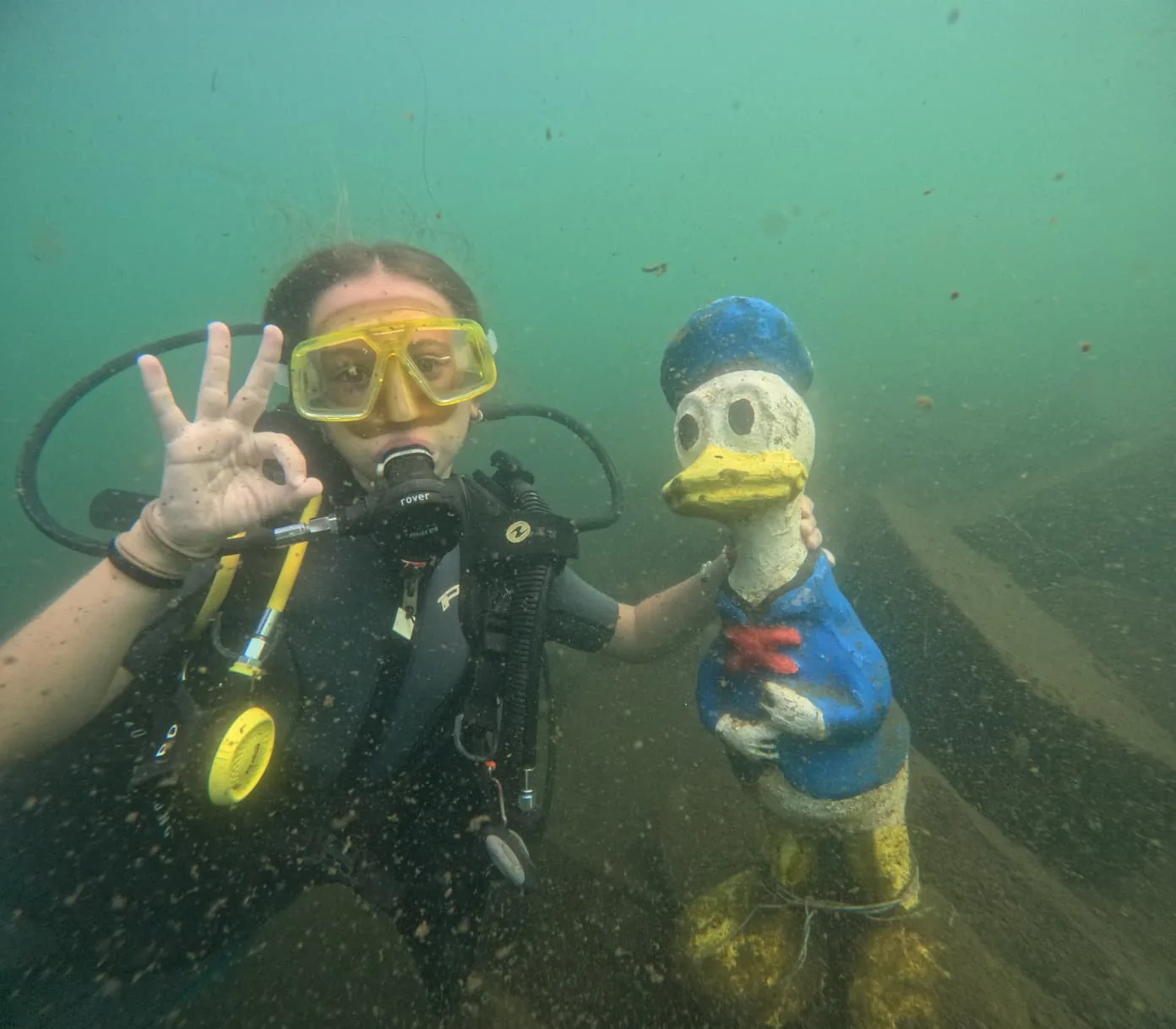
Rock walls cut by the quarry machines 50 years ago, wolf fish hanging in the shadows, armoured catfish, freshwater turtles, sábalos and bogas in the shallows, and, on the floor, a statue of Donald Duck.
Where is it, and how do I get there?
At Salto Grande, about 15 km north of Salto, in the quarry that supplied the rock for the dam. The meeting point and time come with my confirmation, and I can arrange a taxi from the city.
To see it from below, I can arrange a guided scuba diving experience at Cantera El Terrible: certified instructor, full gear, and discovery dives for complete beginners.