Words by Mathias Nicola · August 2026 · Revised 31 October 2026
There is a city in Uruguay, small and sitting on the river that separates it from Argentina, that has produced more world-class footballers per square kilometre than almost anywhere on earth. That city is Salto. The story of its football runs from the Paris of the 1920s all the way to the pitches of Barcelona and the Parc des Princes, and it starts, for the two best known, at one small club in the same city.
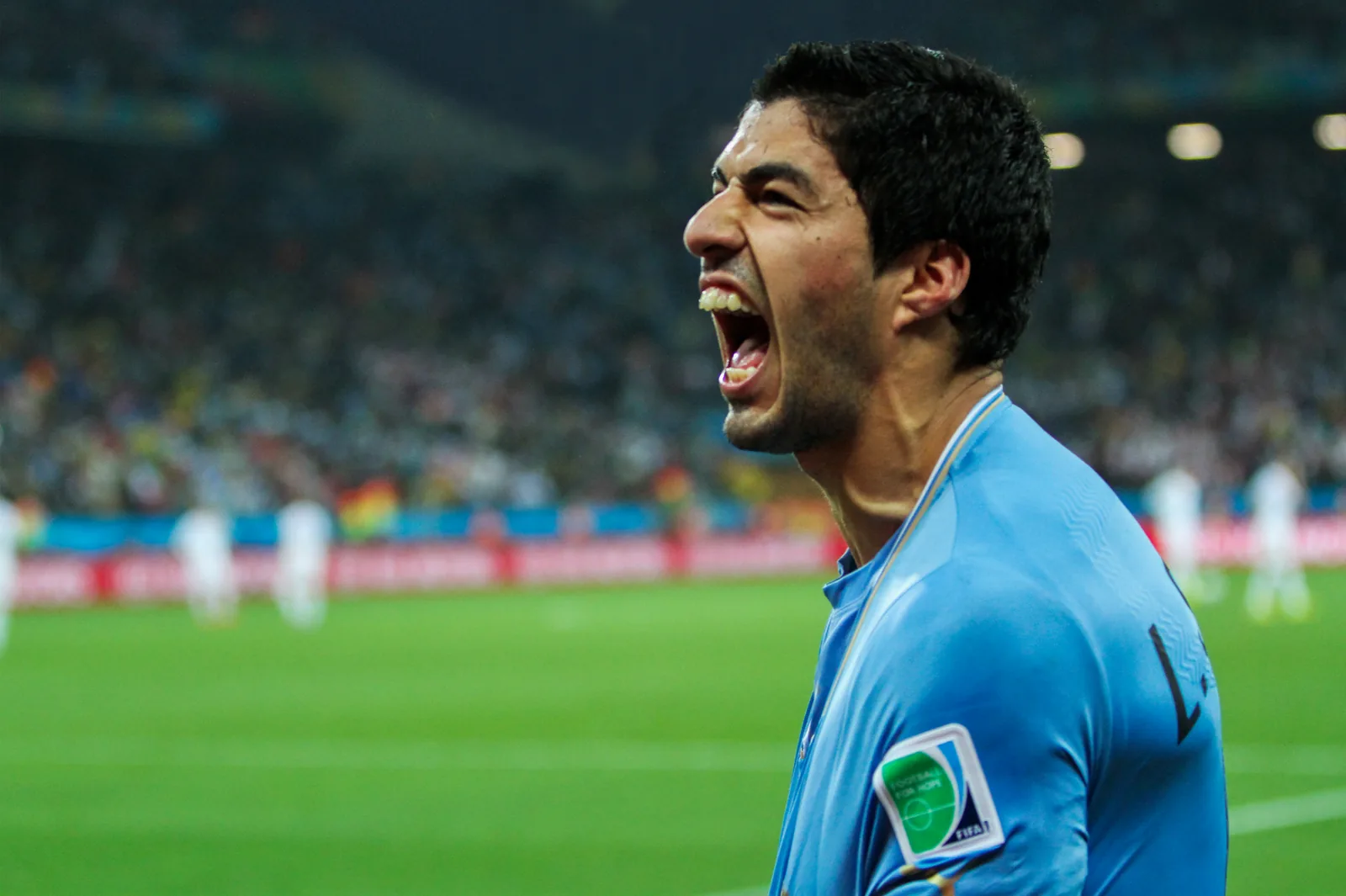
Luis Suárez was born in Salto on 24 January 1987. He left for Montevideo as a small boy, and from there the story is the one the world knows: Ajax, Liverpool and Barcelona, where he won four La Liga titles and a Champions League. At the 2010 and 2014 World Cups he carried Uruguay on his back, his instincts raw, his goals seemingly conjured from desperation alone.
Edinson Cavani was born in Salto on 14 February 1987, three weeks after Suárez, in the same city and the same year. At Paris Saint-Germain he became the club's all-time leading scorer, a record that stood until 2021. Elegant, precise and brutal in the penalty area, he became one of the most complete centre-forwards in the history of the game.
Before any of that, both of them played as boys for Nacional Fútbol Club, a neighbourhood club in Salto. Two of the best strikers of their generation out of one small club, in one city of the interior: I do not know of another case like it anywhere in football.
“Two boys from the same small city, born three weeks apart, and the same boyhood club. Football has never produced a coincidence quite like Salto.”
What a football fan can see
There is a statue of Luis Suárez on Calle Uruguay, the main street of the city. And in Daymán, 10 km south by the hot springs, two streets were named after them not long ago, and they meet: the corner of Luis Suárez and Edinson Cavani, with both signs on one post. If you want one photograph with the two names in it, that is the corner.
Salto does not package its footballers. The statue, the corner and a walk through the centre are what there is, and the city is more interesting for it.
The two of them and the city
Cavani has kept a foot here. He bought land just across the Daymán river, on the Paysandú side, and in Salto he is known for liking the country life around it. Suárez left for Montevideo as a small boy and, as far as anyone here knows, has not been back since his career took him to Europe. I do not think there is a salteño who does not quietly hope he will come back one day, so the city can pay him the tribute it owes him.
La Maravilla Negra, a century earlier
Salto's football story does not begin in 1987. It begins nearly a century earlier, with a man who dazzled the French capital when most Europeans had never seen a Uruguayan play.
José Leandro Andrade, known to history as La Maravilla Negra, the Black Marvel, was born in Salto in 1901. He was the son of a Brazilian drummer and a Uruguayan mother, and he grew up in the Afro-Uruguayan community of the interior at a time when Uruguay was quietly inventing the modern game.
In 1924 Andrade travelled to Paris with the Uruguayan national team for the Olympic Games. Europe had never seen football played like this. Uruguay's style, fluid and technical, invented on the waste-ground pitches (potreros) of Montevideo and Salto, was something entirely new. At the centre of it was Andrade: a midfielder of extraordinary grace, power and vision who could control a match the way a conductor controls an orchestra.
The French press lost their heads. Parisians flocked to watch him train, and journalists called him “the wonder of the tournament”. Uruguay won the Olympic gold medal. Four years later, at the 1928 Amsterdam Olympics, they won it again, with Andrade once more at the heart of everything. And in 1930, at the first World Cup, held in Uruguay, La Maravilla Negra was part of the team that lifted the trophy in Montevideo.
Two Olympic golds and the first World Cup for Andrade. Two of the greatest strikers of the modern era. All from one city. All from Salto.
There is no easy explanation for this. Some point to the hot-spring water, half joking. Others point to poverty and desire, the classic engine of South American football. But those who know the city best say it is something in the character of the place: the stubbornness of the interior, the pride of people who feel overlooked and have always played with something to prove.
When you walk the streets of Salto today, you walk where Suárez and Cavani kicked their first ball, and where Andrade learned to dance with it. The city does not advertise this loudly. It does not need to.
What people ask
Where are Luis Suárez and Edinson Cavani from?
Both were born in Salto, Uruguay, in 1987, three weeks apart: Suárez on 24 January, Cavani on 14 February. Both played as boys for Nacional Fútbol Club, a neighbourhood club in the city.
Is there a Luis Suárez statue in Salto?
Yes, on Calle Uruguay, the main street of the city. The other stop is in Daymán, 10 km south by the hot springs, where the two streets named after Suárez and Cavani meet at one corner, with both signs on one post.
Did Suárez and Cavani play for the same club?
As boys, yes: Nacional Fútbol Club in Salto, before Suárez moved to Montevideo as a child and Cavani went on to Danubio and then Palermo.
Sources
- The club, the statue on Calle Uruguay and the corner in Daymán: seen in Salto, Mathias Nicola, October 2026.
- Wikipedia · Luis Suárez, Edinson Cavani and José Leandro Andrade: dates, clubs and titles.