
Words by Mathias Nicola · August 2026 · Revised October 2026
There is a crossing that no guidebook has done justice to. It does not announce itself. There is no grand terminal, no departure board, no queue of tourists with wheeled luggage. There is a concrete ramp sloping into the brown water of the Uruguay River, a small wooden booth, and an iron-hulled boat, named with quiet affection Don Demetrio, that the Sancristobal family has been steering back and forth, Uruguay to Argentina and Argentina to Uruguay, for as long as most people in Salto can remember.
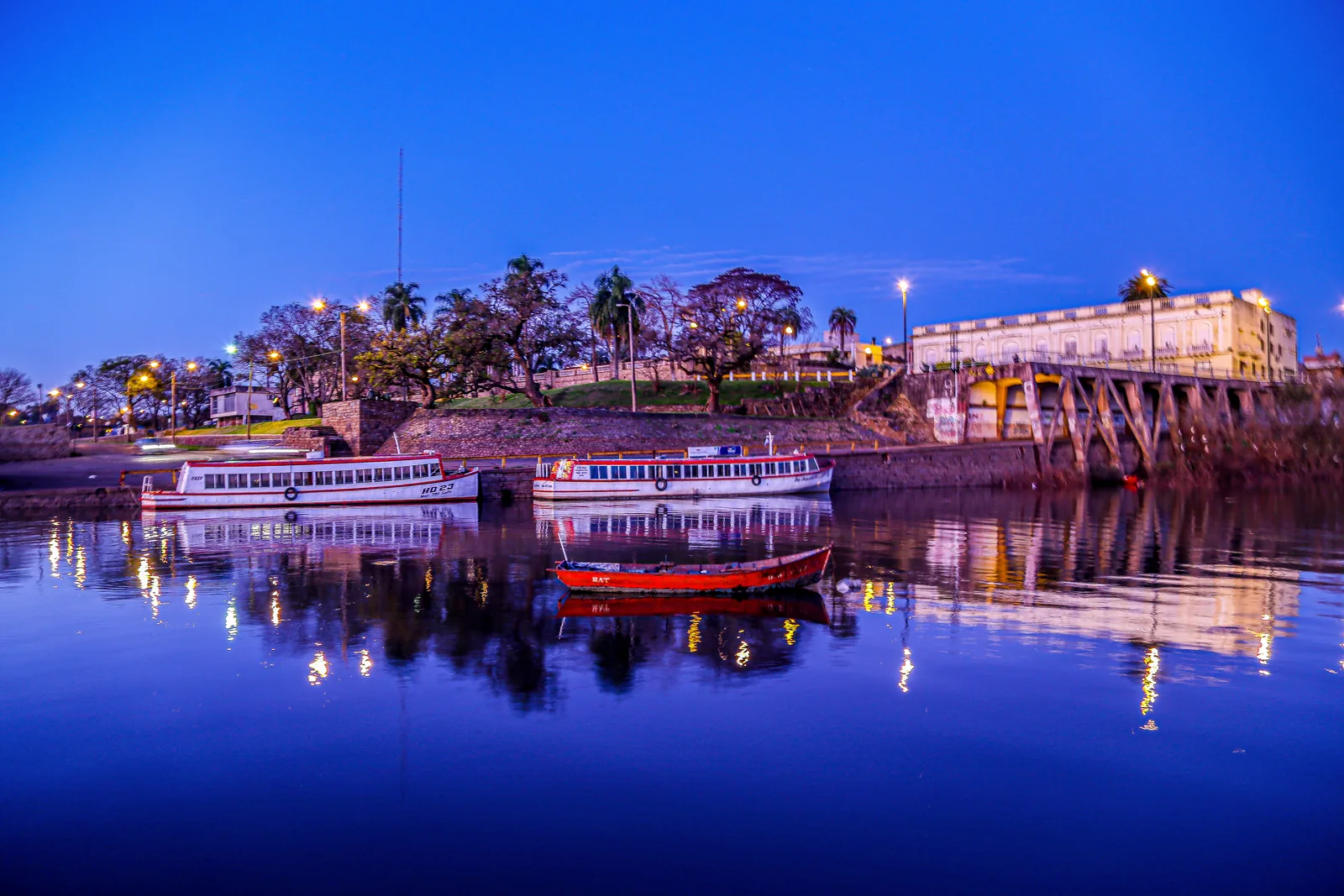
Generations of the same family. The same river. The same 10 minutes.
The boat (lancha) leaves from the port of Salto. Anyone who is not local will probably walk past it twice before finding it, and that is part of the experience.
Don Demetrio is a sturdy, no-nonsense vessel: an iron-hulled boat 19 m long and 3.40 m wide, built to carry up to 88 passengers and a crew of two. She is not built for speed or spectacle. She is built to cross a river, reliably, trip after trip, in all weathers.
The crossing takes 10 minutes. The Uruguay River here is wide but not violent, a broad, amber-coloured river moving steadily south towards the Plata. On a clear morning the Argentine bank at Concordia comes into view almost at once, low and green, a city of squares and old mansions behind a modest waterfront. But in those 10 minutes something happens that is hard to explain to someone who has not done it.
Stepping aboard the Sancristobal lancha is stepping into a different kind of time, unhurried and slightly out of focus at the edges, the kind that belongs more to literature than to transport. Something in the chug of the engine and the slide of brown water along the hull recalls a Juan Carlos Onetti novel: the sense of being neither here nor there, suspended between two banks that are also two countries, a crossing that goes somewhere but is mostly about the act of crossing.
“You leave one country and enter another, not through an airport or a tunnel or a bridge with tollbooths, but by river. By water. The way people crossed before borders were invented.”
The River That United, Not Divided
Before there was a Uruguay and an Argentina, before the treaties, the flags and the passports, there was only the Banda Oriental, and the Uruguay River was not a border. It was a road.
The people on the eastern bank and the people on the western bank were the same people. They crossed back and forth not because two countries allowed it but because the river joined them. Naides era más que naides, nobody was more than anybody, and the river understood that, flowing past jurisdictions it predated by centuries.
It was on this stretch of water that José Gervasio Artigas, the founding father of Uruguay and the great leader (caudillo) of the Banda Oriental, made one of the most extraordinary journeys in South American history. In 1811, in the retreat known as La Redota, Artigas led his whole people into exile rather than surrender: thousands of families, gauchos, indigenous communities, the poor and the dispossessed, crossing the Uruguay River just 2 km upstream from where the lancha runs today, at the Arroyo Ayuí, on their long march towards Paraguay. It was not a military crossing. It was a people on the move, carrying everything they had, following a man who believed in something larger than any border.
The river held them. It has been holding people ever since.
· · ·
The Sancristobal Family: Generations on the Water
The boat has a name, Don Demetrio, painted in fading letters along the hull, and people here speak of it the way you might speak of an old, dependable friend rather than a piece of machinery. The first Sancristobal to run this crossing did so when it was simply how things worked: before the Salto Grande Bridge existed, the river was the only way between Salto and Concordia for ordinary people without horses or the means for longer routes. Necessity became a trade, and the trade became an inheritance.
Today the family still runs the same crossing. They know the river the way you only know something you were born into: its moods, its currents, the way it rises after heavy rain in Brazil, the quality of the light on the water in winter when the mist comes off the Iberá wetlands to the north. They know their passengers too: the regulars, the farmers, the students, the occasional foreigner who has come a very long way for a very short boat ride.
There is a dignity in that continuity that most businesses never achieve. The same family, the same river, the same 10 minutes, passed down and kept going. In an age of disruption there is something quietly radical about it.
· · ·
The Crossing Itself
The ticket is bought at the small office on the Salto waterfront, unhurried, with no online booking. The fare is paid in Uruguayan pesos, about US$10 a person return, in exchange for something like a receipt, and then you wait on a plastic chair or against the railing watching the river go by. Sparrows flick between the dock pilings. The smell is of river water and diesel and the warm humidity that South American waterways carry in summer.
When the boat is ready, and it is ready when it is ready, you walk down the ramp and step aboard. The lancha holds up to 88 passengers and two crew, though most crossings are far quieter than that. You sit on benches along the sides or in the middle, facing forward or back depending on the bench. There is something pleasantly democratic about it. The farmer with the boxes sits next to the American with the passport pouch under his shirt. They do not speak the same language. They are crossing the same river.
The engine turns over, a low diesel rumble you feel as much as hear, and the boat pulls away from the Uruguayan bank. The waterfront of Salto recedes: the old port buildings, the promenade, the cathedral tower behind the rooftops. For a moment you are on neither side of anything. You are on the river, which belongs to both countries and to neither, which was old before either existed, and which will outlast whatever lines are drawn across it.
Then the Argentine bank arrives. The boat docks. You walk up a ramp into Concordia. You have crossed an international border, changed countries, and moved between two currencies and two sets of laws.
· · ·
Why It Matters
Most travel between Salto and Concordia goes over the Salto Grande Bridge, the international crossing that carries the highway traffic, the lorries and the tour buses. It is efficient and sensible. It takes perhaps 20 minutes by car, with a proper border post on each side, customs officers, passport stamps and the mild anxiety of having your bags x-rayed.
The lancha is none of those things. It is slow travel made honest almost by accident, because there is nowhere to go and nothing to do for 10 minutes but watch the river and think about where you are.
The lancha is a mild revelation: two countries sharing a river so calmly, letting a small boat go back and forth between them with so little fuss. There is something moving, too, about a crossing that still works exactly the way crossings always worked: a boat, a family, two banks, and the water in between.
And under both is the older history: a river that once joined a single people, that carried Artigas and his thousands into exile, and that the Sancristobal family has been crossing, year after year, without ever treating it as ordinary.
“You do not need a reason to take the lancha. The crossing is the reason.”
Practical Notes
The lancha runs from the port of Salto, operated by the Sancristobal family, on Mondays, Wednesdays and Fridays, leaving Salto at 9am and 4pm and returning from Concordia at 9.30am and 4.30pm. Being at the port 30 minutes before departure is the rule, and the timetable can shift with the river and with commercial conditions, so it is worth confirming close to the date; I can book the crossing for you on operating days. A passport is needed, and immigration is handled at each dock. Local cash in small notes is the easiest way to pay.
At weekends the Sancristobal lancha also runs river excursions, a slower trip along the Uruguay River for anyone who wants more of the water and less of the destination. It is one of the better ways to get a sense of the size and temper of the river without going anywhere in particular.
Worth knowing: the ticket includes a bicycle at no extra cost. That turns the crossing into something more than a border formality: you can pedal off the boat in Concordia, spend the morning on its tree-lined waterfront and in its elegant centre, and sail back in the afternoon, having seen two cities and two countries from two wheels and one good river.
Concordia, on the Argentine side, rewards a morning or an afternoon: a city of slightly faded elegance, good coffee, and the particular quiet of a provincial Argentine town on a weekday. But the lancha is not really a way of getting to Concordia. It is the destination in itself, a 10-minute crossing that leaves you feeling you have gone somewhere much further than the opposite bank.
The Uruguay River will take you there. It has been taking people there for a very long time.
The river is already moving south.
Don Demetrio crosses on Mondays, Wednesdays and Fridays, and I can hold you a seat.
River Crossing by Boat →