
Words by Mathias Nicola · October 2026
Not long ago a couple from Germany cancelled their trip to Salto. They had seen the news: the Uruguay River was rising, families were preparing to leave their homes, and the emergency committee was meeting every day. They decided it was not the right time to come. Other people cancel for less, usually a forecast with a few days of rain in it. I understand both, but the news only tells half the story. Salto is not a beach. This note explains what a high river changes, what rain changes, and what carries on regardless.
The news is true. When the river is high, the port closes, the lowest streets by the water flood, and the CECOED, the local emergency committee, moves families out of their homes once the gauge gets close to 12 m. It is also true that a city of 114,000 people carries on above the flood line. The hotels, restaurants, museums, bus terminal and airport are nowhere near the water. The hot springs, which are the main reason people come, are on other rivers altogether, and they have covered pools for rainy days.
Salto is a year-round destination. The hot springs have always been as popular in winter as in summer, and the city depends partly on its visitors. A high river is exactly when the cancellations come in, and exactly when the people who run the hotels, restaurants and pools need visitors most.

Where to check the river
When the river is high I keep two pages open, both on saltouruguay.com, a Salto site I also run. The river page shows the height at the port, updated every 15 minutes from the Salto Grande station, plus the last 30 days, the key levels on the gauge and every major flood since 1959. The home page has the 5-day forecast from Inumet, Uruguay's national weather service, which also issues the colour-coded weather warnings.
How a river rise works here
The Uruguay River does not flood Salto the way a flash flood hits a mountain town. The water comes from rain in the upper basin, in southern Brazil and the Argentine provinces of Misiones and Corrientes, and it takes days to arrive: about 10 days from the upper basin and 2 days from the lower one. The Salto Grande dam, 15 km upstream of the port, controls what comes down. The reservoir cannot stop a big flood, because once the lake is full the water has to go out through the spillway. But it does lower the peaks, by up to 3 m in the biggest floods according to the Comisión Técnica Mixta, the binational body that runs the dam. Without the dam, the rise of August 2026 would have reached 12.20 to 12.30 m instead of about 11.6 m.
Every day at 1 pm the Comisión publishes the maximum height it expects at Salto, and the CECOED tracks the river daily and plans any evacuations in advance. In other words, a rise is announced days ahead, and it builds slowly enough to plan around.
The river is measured on the gauge at the port, in metres above the port's local zero. These are the levels that matter.
| On the gauge | What happens in Salto |
|---|---|
| 10.55 m | The Prefectura, the port authority, closes the port and stops all boat traffic, including the passenger boat to Concordia. |
| 10.8 m | The first houses in the lowest streets by the river are affected. |
| 11.30 m | Alert level, set by the Comisión Técnica Mixta de Salto Grande, the binational body that runs the dam. |
| 12 m | Safety level. From about here the CECOED, the local emergency committee, starts moving families out of their homes. |
| 13 m | Around 20 streets are closed, including the two costaneras, the riverside avenues. |
| 16.37 m | The highest level since the dam was built, on 27 December 2015. |
| 18.17 m | The flood of April 1959, before the dam existed. |
The people who have to leave live in the lowest streets along the river: the two costaneras, the riverside avenues north and south of the port, and the blocks just behind them. The city centre sits on a bluff above all of this. Even in April 1959, the worst flood on record, the river reached 18 m with no dam to hold it back. The water got to the bottom of Calle Uruguay, the main street, by the old customs house, and stopped a block short of the Intendencia, the city hall. The rest of the centre stayed dry, and it has stayed dry in every flood since. Plaza Artigas, the hotels in the centre, the bus terminal, the museums and the restaurants are never part of the picture.
| Flood | Height at the port | People displaced in Salto |
|---|---|---|
| December 2015 | 16.37 m | 3,051 |
| June 2017 | 15.10 m | about 1,300 |
| November 2023 | 14.00 m | 1,185 |
| May 2024 | 13.83 m | 896 |
| June 2025 | 12.61 m | about 50 |
| August 2026 | 11.58 m | none |
These figures include both the families taken to shelters and those who moved in with relatives. In the worst flood since the dam was built, that was 3 people in every 100.
The pictures that make the news show the costanera under water, the port cranes standing in the river, and low houses with water at the door. They are real, but they show a narrow strip along the river, not the city.
Where the hot springs are
None of Salto's hot springs are on the Uruguay River. Termas del Daymán, 10 km south of the city on Route 3, is on the Daymán River, and so is Parque Termal Agua Clara, 7 km from town. Termas del Arapey is 80 km to the north-east, on the Arapey River, in open countryside. Termas de Salto Grande and the Hotel Horacio Quiroga are on the shore of the lake behind the dam, about 15 km north. The hot water itself comes up from 1,000 to 2,200 m underground, from the Guaraní Aquifer, and has nothing to do with the river level.
The Daymán River can rise after heavy local rain. It did in August 2026, when the water reached the edge of the park at Termas del Daymán. The pools stayed open the whole time, from 8am to 10pm. The CECOED described the Daymán as a river that rises quickly and drops again within hours.
When it rains for days
Uruguay has no rainy season. Rain comes in spells of a day or two, spread across the year, and Inumet's forecast picks them up 5 days ahead, with a colour-coded warning when a storm is going to be severe. A rainy week in Salto is rarely 7 days of rain. It is usually 2 or 3 wet days with dry ones in between.
Rain changes the order of your days, not the trip. At a beach, rain ruins the holiday. At the hot springs it is part of the experience. The water comes out of the ground at 39 to 46 °C whatever the sky is doing, and the pools are open every day of the year. The hot springs have always been busiest in the cold months, not the warm ones. The people who cancel simply leave the pools quieter for everyone else.
The only thing that clears the open-air pools is lightning, and only while it lasts, which here means hours rather than days. For that hour there is the covered pool, the spa or the thermal bath in your room. The rest is a question of planning: the pools, the museums, Energimundo with children and a long lunch on the wet days; the countryside, the river and the walks on the dry ones. The next section lists the covered pools.
Hot water under a roof
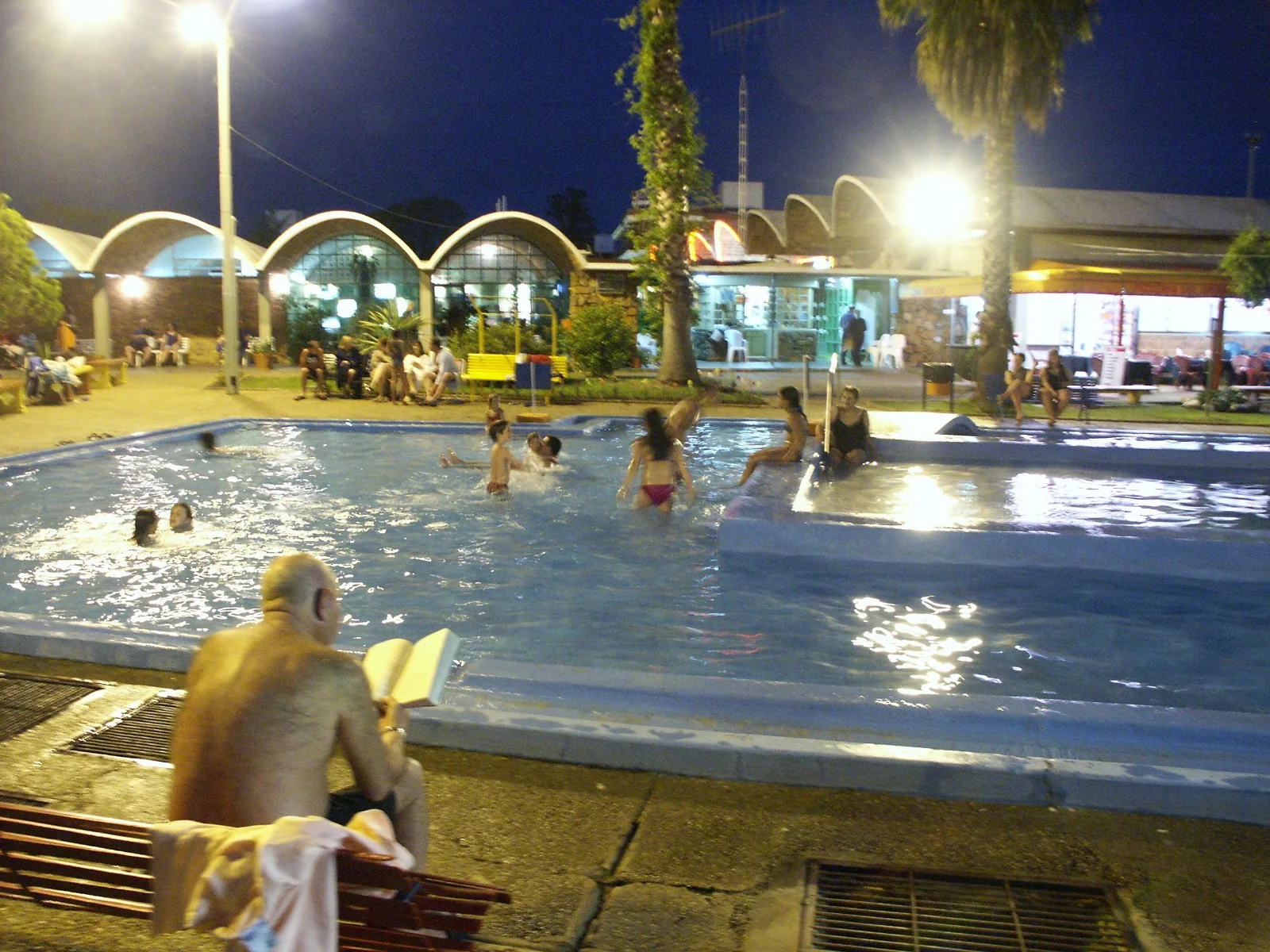
Rain is not a problem at the hot springs. Cold rain on your shoulders while the rest of you sits in hot water is one of the best feelings Salto has to offer. When there is thunder around, the covered pools are the place to be, and most of the hot springs have at least one.
| Where | Under a roof | Good to know |
|---|---|---|
| Termas del Daymán, the municipal park 10 km south, on the Daymán River | The main pool has had a roof since November 2025, a tensioned cover on a new steel frame. The pools range from about 32 to 44 °C. | Open every day, 8am to 10pm. General entry UYU 200 (about US$5), under 12 UYU 120, under 6 free, paid at the ticket office. No bookings (Intendencia de Salto, October 2026). |
| Hotels at Daymán | Posada del Siglo XIX has open-air and covered thermal pools fed by its own well, 800 m from the park. Hotel Termal Daymán has an open-air pool and a heated indoor one. Aguasol Hotel Termal has covered and open-air pools, all thermal water. | Pools are for guests only. The Stay page describes the area. |
| Parque Termal Agua Clara 7 km from town, on the Daymán River | One of its 4 pools is semi-covered, and it has hydrotherapy showers. | Open every day, 8am to 10pm. General entry UYU 300 (about US$8) at the entrance, no bookings. |
| Termas de Salto Grande · Hotel Horacio Quiroga about 15 km north, on the lake | Guests have 24-hour access to the pools, every room has a thermal hydromassage bath, and the hotel lists a heated covered pool. | The public hot-springs water park takes day visitors: UYU 650 (about US$16), children 4 to 10 and Salto residents UYU 520, every day 10am to 6pm (the park's own price list, October 2026). |
| Termas del Arapey 80 km north-east, on the Arapey River | The municipal complex has covered and open-air pools. Altos del Arapey has a heated indoor-outdoor pool, with a roof on one side and open on the other, plus 5 open-air pools at 39 to 40 °C. The Arapey Thermal resort also has covered pools. | Municipal complex open every day, 8am to 10pm. Both resorts are all-inclusive. |
The city on a wet day
Salto's museums are in the centre, a few blocks apart, and all three open on weekdays only, so a museum afternoon is a Monday-to-Friday plan. The hours below come from the Intendencia's Agenda Salto (October 2026) and change with the season, so it is worth checking on the day. There is a page on the museums in Explore. With children, the children's library of the Biblioteca Felisa Lisasola, open Monday to Friday, 8am to 4pm, is the quiet option.
| Museum | What is there | Open | Address |
|---|---|---|---|
| Museo de Bellas Artes y Artes Decorativas María Irene Olarreaga Gallino | Figari, Petrona Viera, Cúneo and other Uruguayan painters, with sculpture and contemporary and local work, in a 1920s mansion with the city's first lift. Free | Mon–Fri 8am–7pm | Uruguay 1067 |
| Museo Casa Quiroga | The family house of Horacio Quiroga: first editions, letters, one of his bicycles and his mausoleum, plus a room devoted to the poet Marosa di Giorgio | Mon–Fri 8am–6pm | Av. Seregni and Maciel |
| Teatro Larrañaga | The theatre, opened in 1882 and a national historic monument since 1988, visited as a museum during the day. Free | Mon–Fri 8am–6pm | Centre |
In the evening the Teatro Larrañaga goes back to being a theatre. What is on in Salto this week is listed in the agenda on saltouruguay.com.
The dam is worth a visit on a grey day, and even more so when the river is high, because that is usually when the spillway is open. Guided tours from the Uruguayan side run Monday to Friday from 7am to 4pm and on weekends and holidays from 8am to 4pm, and last about 90 minutes: a short film, a talk, a bus ride across the dam to the viewpoint, and a look inside the machine hall. Tours are free and booked in advance, online or on +598 4732 7777, and the only closing days are 1 May, 24, 25 and 31 December and 1 January. The Salto Grande page has the details, the environmental visit, the free Friday bus from the city, and Energimundo, the free science museum beside the dam, which is the wet-day answer with children.
A long lunch is the other classic answer to a rainy day. Salto is where Tannat, now Uruguay's signature grape, was first planted, in Pascual Harriague's vineyard in the 1870s. There is a Journal note about it, and the Food page lists where to drink it.
What stops, and what does not
- The passenger boat to Concordia stops running when the gauge reaches 10.55 m, by order of the Prefectura. You can still cross by the bridge over the dam, which is the route the buses use.
- The riverside walks and the beach at Arenitas Blancas are the first to flood, from about 10.5 m.
- Horse riding, walks, birdwatching, the scenic flight and the beach move to the dry days. The hot springs, the spa, the museums and Energimundo fill the wet ones.
- Dirt roads to the estancias turn to mud after heavy rain. Your host will know the state of the road on the day, and it is best to arrive in daylight.
- Everything else carries on as normal: the hot springs, hotels, restaurants, museums, long-distance buses and flights to Nueva Hespérides airport.
Booking when the forecast looks bad
Flexible rates are the sensible choice when the forecast shows rain or the river is high, and most hotels at the hot springs offer them. A river rise is announced days in advance, the forecast covers 5 days, and the gauge is public, so nobody gets caught out. A light waterproof jacket, sandals for the pools and a dry change of clothes cover most of what a wet week needs.
Rain: comes in spells of a day or two; there is no rainy season. It changes the order of your days, not the trip. Lightning closes the open-air pools only while it lasts.
Under a roof: the main pool at Daymán, the hotel pools at Daymán, the covered pools at Arapey, the thermal bath in every room at the Horacio Quiroga.
With children: Energimundo, the free science museum beside the dam (every day), and the children's library in the centre (Monday to Friday, 8am to 4pm).
What stops: the boat to Concordia from 10.55 m on the gauge; the riverside walks.
Who is affected: the lowest streets along the river. In the worst flood since the dam, 3 people in every 100.
Who to call: emergencies 911; CECOED Salto +598 99 383 807.
The rain passes. The river rises slowly and falls the same way. And the water in the pools stays at around 40 °C.
If your dates fall in a week with rain in the forecast or a high river, I can tell you what each day will look like and send you a short, carefully chosen list of covered pools and what to save for the dry days. Anything I do not know, I will find out.
Plan your trip →Sources
- El Pueblo, 7 October 2026 · Creciente del río Uruguay: Salto prepara evacuaciones
- Radio Libertadores, 7 October 2026 · Comité Departamental de Emergencias en sesión permanente
- El Pueblo, 6 October 2026 · Se continúa monitoreando la crecida del río Uruguay
- Diario Cambio, 3 August 2026 · Aquiles Mainardi (CECOED): evacuations would begin at 12 m
- Diario Cambio, 1 August 2026 · Prefectura del Puerto de Salto: the port closes at 10.55 m
- Intendencia de Salto, 8 August 2026 · the river receded with no evacuations
- El Pueblo, 12 August 2026 · without the dam the August rise would have reached 12.20 to 12.30 m
- DINAGUA, 11 September 2023 · situation report (first houses, Arenitas Blancas, urban level)
- Intendencia de Salto, 28 November 2023 · situation report, 1,185 displaced
- SINAE, 23 May 2024 · situation report, 896 displaced in Salto
- Telenoche, 27 June 2025 · about fifty displaced in Salto
- En Perspectiva, 28 December 2015 · 3,051 displaced, the second largest flood since 1959
- 180.com.uy, 12 June 2017 · Salto Grande: more water than in 1959, 15.10 m at the port
- El Pueblo, 13 July 2014 · 1959, the year of the greatest drama
- Comisión Técnica Mixta de Salto Grande · daily hydrology communiqué, with the expected maximum at Salto
- Comisión Técnica Mixta de Salto Grande · characteristics of the dam
- Zotelo, Martín and Camilloni (2007) · response times of the Uruguay River basin
- Salto Grande · guided visits
- La Prensa, 21 August 2026 · Termas del Daymán open despite the rise of the Daymán River
- El Heraldo, August 2026 · the Daymán River rises and reaches sectors of the park
- El Telégrafo, 26 November 2025 · the new cover of the main pool at Termas del Daymán
- Amo Termas · prices and hours of Termas del Daymán (August 2026)
- Amo Termas · Termas de Salto Grande, day entry and hours
- Amo Termas · hotels with heated pools at Termas del Daymán
- Posada del Siglo XIX · open and covered thermal pools, own well
- Hotel Termal Daymán · services
- Hotel Horacio Quiroga · pools open 24 hours, thermal hydromassage in every room
- Altos del Arapey · heated in-out pool and five open pools
- Viatermal · Termas Municipales de Arapey, covered and open-air pools
- Intendencia de Salto · Museos de Salto (guide, PDF)
- Intendencia de Salto · Agenda Salto / Destino Salto, museum, hot-springs and dam cards, October 2026
- IMPO · Teatro Larrañaga declared a historic monument (resolution 473/1988)
- INE, 2023 census · population of the city of Salto, via Wikipedia