Words by Mathias Nicola · October 2026
The golden dorado (Salminus brasiliensis) is not a fish. It is an event. When one takes your line on the Uruguay River, the rod bends so violently and the reel screams so loud that the first-time angler instinctively steps back. Experienced fishermen from Argentina and Brazil travel to Salto specifically for this moment.
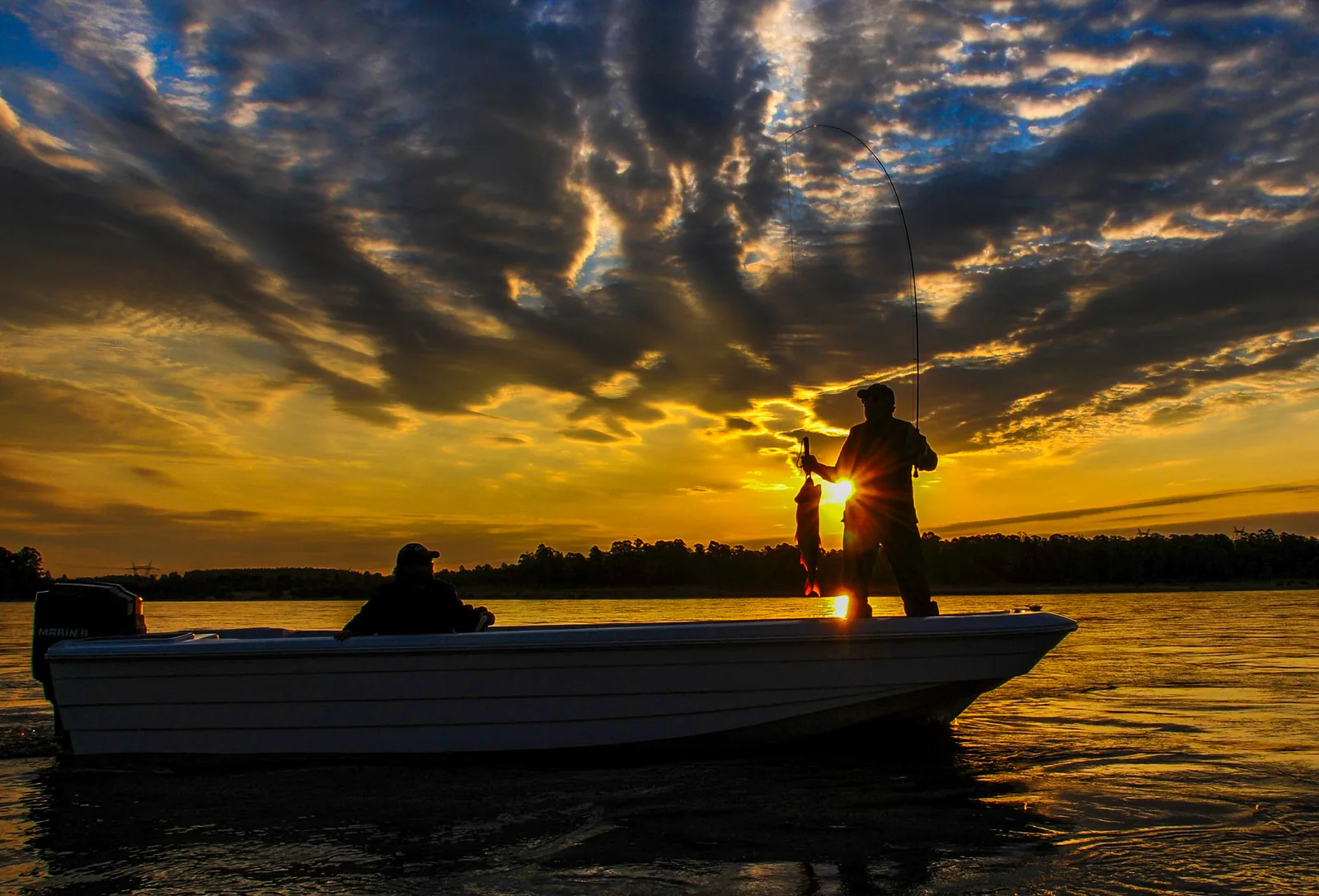
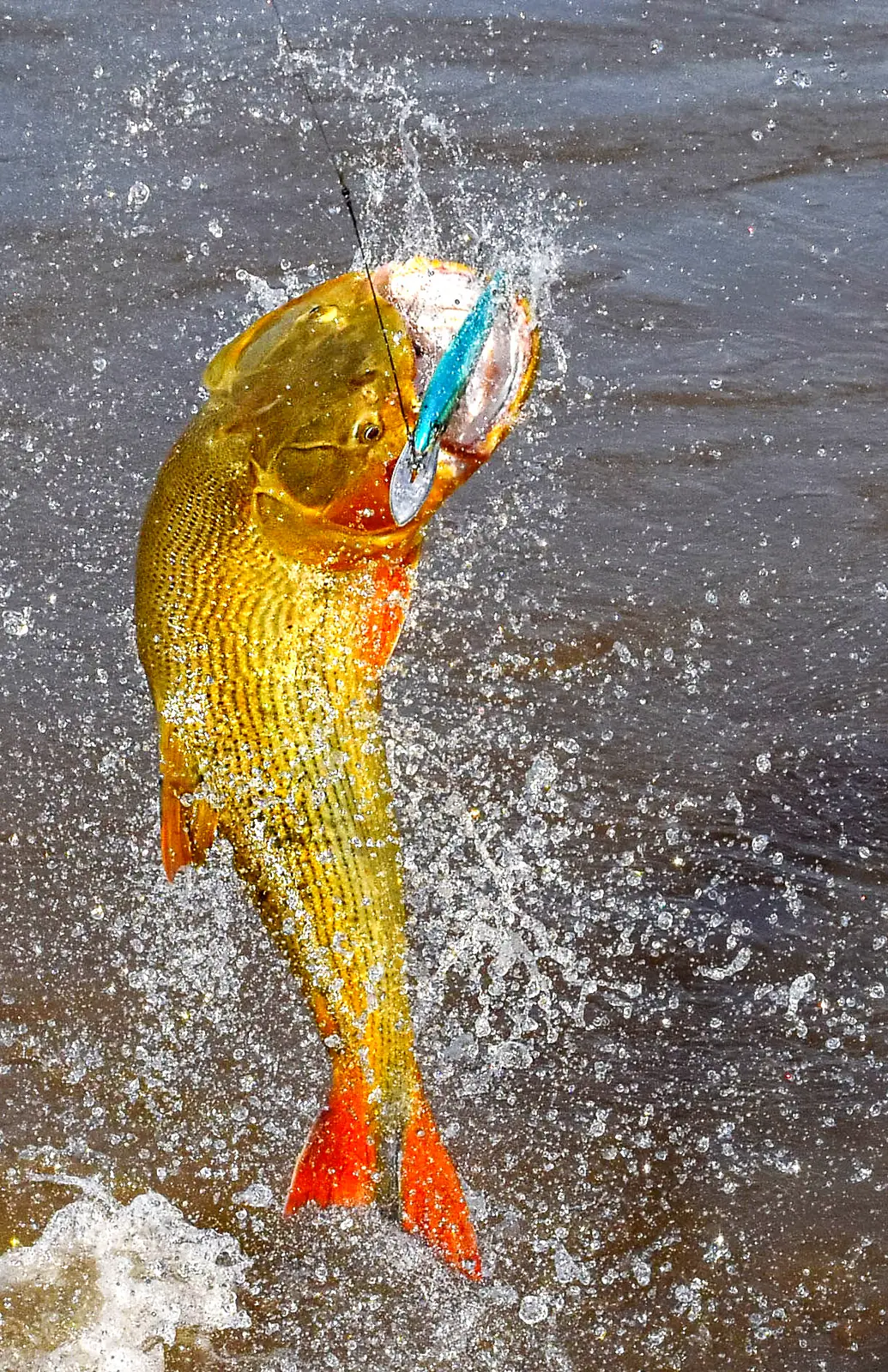
Known as the golden dorado for the extraordinary amber and gold of its scales, this freshwater predator fights with a ferocity that has earned it the nickname tigre del río, the tiger of the river. It leaps. It runs. It changes direction without warning. Landing one is a physical and psychological contest that fishermen describe long after the trip is over. And the biggest one ever put on a certified scale came out of this river: the all-tackle world record, 25.28 kilos, was caught on the Uruguay River at the Argentine-Uruguayan border in 2006, and nobody has beaten it since.
One thing to clear up for anglers from the United States: this is not the dorado of the salt water, the mahi-mahi or dolphinfish. The golden dorado is a freshwater fish of the great rivers of South America, the Paraná, the Paraguay and the Uruguay among them, and the Uruguay River below the Salto Grande dam is one of the places it grows biggest.
Fishing in Uruguay, in short
If you have searched for fishing in Uruguay and landed here, this is the short version. The big freshwater fish of the country live in the Uruguay River, the border with Argentina, and the stretch everyone talks about is the 15 kilometres below the Salto Grande dam, at Salto. The world record dorado on rod and line, 25.28 kilos, came out of this river in 2006. The other two fish worth the trip are the surubí, a catfish that reaches 50 kilos here, and the boga, the summer fish of the rocks. The guides fish dorado and surubí all year round; the boga runs from November to the middle of April.
The local guides fish with lures and live bait, and one lodge on the river sells fly fishing. As a boy in Salto I dug for worms and studied the lures in the fishing shops; a fly rod I never saw. In the regulated water under the dam the rules allow only artificial lures, cast fly, spinning or baitcasting style, with no bait and no trolling. From a boat every fish goes back; from the bank with a rod you may keep what the sizes allow, and nobody asks for a licence on this side of the river. Salto is about 6 hours by bus from Montevideo, there is a direct bus from Buenos Aires, and the details are on the Getting There page. The rest of this note is the long version: why the fish gather here, how La Zona works, and what the rules say.
Why the fish are here
Four of the river's great fish, the dorado, the surubí, the boga and the sábalo, are migrants. Every spring, as the water warms, they move upstream to spawn, and they keep going until something stops them. For two centuries the thing that stopped them was also the thing that gave this town its name: the rapids of Salto Grande and Salto Chico, two ledges of basalt that crossed the river and broke it into white water. They stopped the boats as well. In 1756 the expedition of the Spanish governor Viana halted here because it could sail no further, and the following year a fort went up, San Antonio del Salto Chico. The city grew at the point where cargo had to come off the boats and go round the rapids by land. The fish and the port had the same cause.
In 1979 the rapids went under a wall. The Salto Grande dam, built by the two countries and run by their Comisión Técnica Mixta, sits fifteen kilometres north of Salto and of Concordia: 852 metres of concrete, 69 metres from its foundations, fourteen Kaplan turbines, and a reservoir 140 kilometres long with the old Salto Grande falls somewhere at the bottom of it. The road and railway on top of it are the border crossing.
The dam has two fish locks, Borland lifts that were the first of their kind in Latin America when they started working in 1984. They were meant to carry the migrants up into the lake. A study published by the FAO found that they mostly carry small fish: schools of the big species get through in fewer than five per cent of the lock cycles. So the wall is, for all practical purposes, the end of the road. The dorado arrive, cannot pass, and gather in the tailrace by the hundred. The surveys made after the dam closed recorded fish massed across the whole width of the river in a strip two or three hundred metres below the turbines, and the biologists noted that fifteen or twenty metres from the turbine outlets there were always dorado to be had on a hand line.
Add to that what the turbines do to the water. The reservoir breeds baitfish and eels; they come through the machines stunned, and the water comes out fast and full of oxygen. A predator that hunts by sight and speed could not design a better place. Concordia's tourism office puts it plainly: the biggest dorado of the whole river are caught against the dam wall, the final point of the spawning run, and they go from four to twenty-five kilos. A fishing writer from Buenos Aires called the stretch a true aquarium of big dorado. The Intendencia de Salto claims twenty-two world records in four seasons for this water, and the lodge on the Argentine bank claims more than twenty of its own. The International Game Fish Association has been certifying records here for decades, which is why people who have fished the Amazon and the Paraná still come to a hydroelectric dam on the Uruguay.
La Zona: four boats below the wall
The water directly under the dam is not open to anyone who turns up. Two binational bodies decide what happens there. The Comisión Técnica Mixta runs the dam and marks out a safety zone that reaches roughly a kilometre downstream. The Comisión Administradora del Río Uruguay, CARU, created by the river statute that Argentina and Uruguay signed in Salto on 26 February 1975 and based in Paysandú, writes the fishing rules for the whole shared stretch of the river, and the same rules apply on both banks.
For the water under the wall CARU has a regulation whose name tells you everything: the Reglamento de Pesca y Devolución, the fishing-and-return rules. In the first 500 metres below the dam nothing at all is allowed, no boat, no swimmer, no line; CARU drew that line in 2016, moved it to 200 metres in 2023 and put it back at 500 metres with a resolution published on 28 September 2026. From that line to the end of the safety zone, sport fishing is allowed only through a permit holder, and each country may authorise exactly one. On the Argentine bank it is La Zona Lodge, in Concordia. On this bank it is a single Salto operator, whose slots the local guides sell on. Each side puts in two boats, three anglers to a boat, in three-hour shifts, Monday to Thursday, in daylight only. Lures or flies, no trolling, barbless hooks, a knotless landing net, no fish out of the water for more than two minutes, and every fish back where it was caught, without exception. Four boats on about half a kilometre of river that holds the biggest dorado in the world: that is why the regulars call it simply La Zona.
It has not always run smoothly. The Uruguayan permit sat unused for several years until the government put it out to public tender in August 2020, and the local press called the decision long awaited. Across the river, the Argentine boats lost their access for years and only got it back in 2026. Poachers' nets still come out of the safety zone from time to time with dead dorado in them, and the guides' association in Concordia makes sure the newspapers hear about it. The rules are strict because the place is worth protecting, and because everyone who fishes it knows what the alternative looks like.
If you want to fish that last stretch with me, it is a separate booking: a three-hour slot, Monday to Thursday, usually reserved a month ahead. Three hours is enough. A boat full of dorado trying to cross the dam is tiring in a way that is hard to explain to someone who has not been in it.
Below the zone: a reserve, a rapid and ten kilometres of bank
What most visitors never hear is that the good fishing does not stop at the end of the safety zone. In 2018 Uruguay declared the river from 1,000 metres below the dam all the way down to the port of Salto, to the red light that flashes every five seconds at the end of the pier, a reserve for sport fishing. Commercial fishing was phased out over two years because, in the words of the decree, the stretch accumulates migrating dorado. So between the wall and the town there are no nets, only rods.
In that stretch sits Salto Chico, three kilometres north of the city at the end of the costanera: the surviving rapid, a bar of basalt that runs right across the river to the Argentine side. When the river is at its normal level there are always a few anglers standing on the rocks, and from there up to the edge of the zone, about ten kilometres of bank, dozens of people cast every day of the year. Dorado of more than twenty kilos and surubí of fifty come out of this water. In summer, when the dam holds water back and the river drops, one lodge on this stretch fishes it with fly rods, wading between the rocks; in winter, with the river high, the boats work the same water. That lodge calls itself the first fly-fishing lodge in Uruguay, and I understand why it chose this stretch.
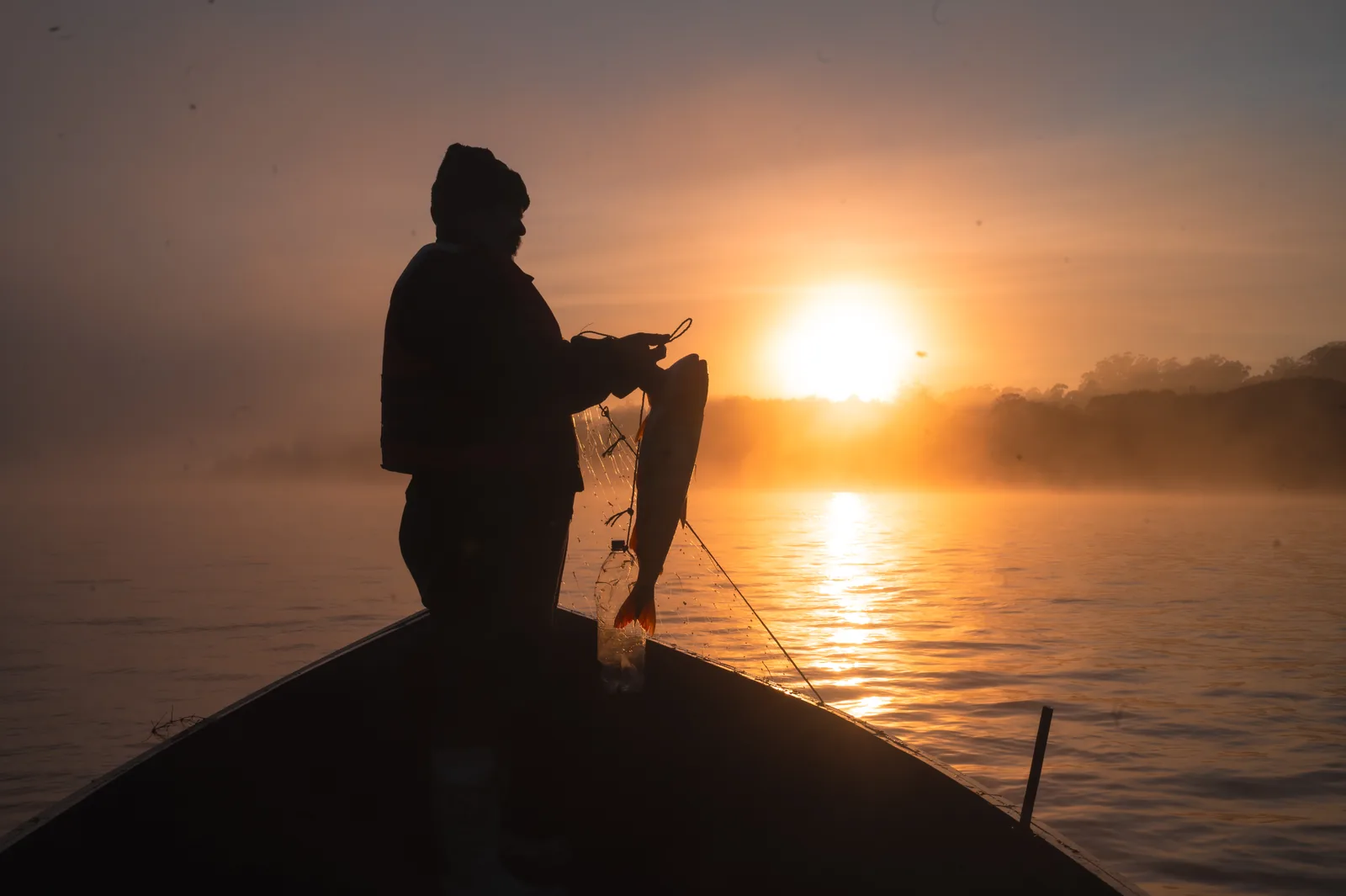
There are more guides here than the size of the town suggests. The Intendencia's own list runs to half a dozen outfits, some with lodges on the river, some with a boat and a trailer. The boats are the ones in Marcelo Cattani's photographs, open hulls with an outboard, and a guide who rigs the rods and handles the fish. Anglers come from Buenos Aires, from the south of Brazil, from the United States and Europe; Fish TV, the Brazilian fishing channel, came to film the dorado of Salto Grande in 2022. Across the river, Concordia has its own guides' association and a fishing camp on the bank, La Tortuga Alegre, fourteen kilometres from the centre, which hosts the national boga festival every April.
The other two: surubí and boga
The surubí pintado (Pseudoplatystoma corruscans) is the other giant of the river: a spotted catfish with a flat head and an enormous mouth, taken at dusk and at night on live bait laid on the bottom. It grows to fifty kilos here, and the CARU minimum is 85 centimetres, which is already a serious fish. Just south of the city, between Corralito and the mouth of the Daymán, four kilometres of river have been closed to surubí fishing by any method since 2007, because the big breeding fish gather there in winter and were being taken too easily. Its striped cousin, the surubí atigrado, is off limits everywhere on the river.
The boga (Megaleporinus obtusidens) is the opposite proposition. The Argentines call it la dama del río, the lady of the river, and it is the summer fish of the shore: November to the middle of April, from the rocks or from an anchored boat, with soaked maize, dough or worms on a small hook and light tackle. The bite is subtle and the fight is out of all proportion to the size, two to seven kilos at Concordia and more in a good year. The minimum is 34 centimetres. It is also the fish that ends up on the parrilla: from a boat on the Uruguay everything goes back, but from the bank with a rod you may keep what the sizes allow, and a boga on the grill is the river's own dish.
The rules, in plain words
CARU's rules are few. From a boat, sport fishing is catch-and-release every day of the week; from the shore with a rod you may keep your fish within the sizes below; commercial fishing is confined to Monday to Thursday in daylight. CARU also decides the closed seasons, and the guides fish inside them. Nobody will ask you for a licence to fish from the bank on this side of the river, and the guides' boats carry their own papers. In Entre Ríos, across the water, the province sells a sport-fishing licence.
| Species | Minimum size |
|---|---|
| Dorado | 65 cm |
| Surubí pintado | 85 cm |
| Patí | 40 cm |
| Boga | 34 cm |
| Sábalo | 34 cm |
| Tararira | 33 cm |
| Pejerrey | 25 cm |
| Bagre amarillo | 20 cm |
| Surubí atigrado, armado | No fishing at all |
Standard length, as set by CARU. Anything under size goes back in the water.
Who: one permit holder on each bank, La Zona Lodge in Concordia and one operator in Salto; two boats each, three anglers per boat.
When: three-hour slots, Monday to Thursday, daylight only. Dorado and surubí all year round, boga in summer.
How: lures or flies, no trolling, barbless hooks, a knotless net, two minutes out of the water at most, everything released.
Further down: from the zone to the port of Salto the river is a sport-fishing reserve, with no commercial nets since 2020.
When to come: month by month
Dorado and surubí are fished all year round here, and the guides who work this water every day say so without hesitation. What changes with the months is the river, and with it where and how you fish.
| Months | The river | The fish | How it is fished |
|---|---|---|---|
| March to August | Autumn and winter. The fish begin to stack up under the wall in March, and the river runs high. | Dorado and surubí from the boat; the biggest dorado gather against the dam. | The zone's busiest months: the three-hour slots below the wall go a month ahead. Elsewhere, from the boat. |
| September and October | Spring. The water warms and the migrants move upstream to spawn. | Dorado and surubí. | From the boat in the open river, between the zone and Salto Chico. |
| November to mid-April | Summer. Warm water, and when the dam holds water back the river drops. | Dorado and surubí, and the boga for the shore anglers. | From the boat in the open river; the boga from the rocks or an anchored boat, with soaked maize, dough or worms on a small hook and light tackle. |
| High river, any month | The level changes by the hour with what the turbines are doing. | The same fish. | The same spots from a boat. A good guide checks the dam's releases before anything else. |
In the guides' words: dorado and surubí all year round, boga from November to the middle of April. The zone below the wall is Monday to Thursday, daylight only.
The boat leaves early. The first hour is the river waking up: herons on the sandbanks, the fog lifting off the water, the wall of the dam coming out of the mist upstream. Then the first strike, and the sound of the reel that makes everyone step back the first time.
A day from Salto, not a lodge
Most of what you will read about dorado fishing in South America is written by lodges: three or four nights, every meal, a guide per boat, and you never leave the property. The Uruguay River has lodges too, on both banks. What I arrange is a different product. You sleep in Salto, in whichever hotel suits you, and the boat takes you out for a day of 8 hours, US$400 for the boat, or a half day of 4 hours for US$320: motorboat, fuel, guide, tackle and lures for up to three anglers, a cool box with water and ice, and the video and photos of the day, paid to the operator on the day. In the evening you are back in a city with restaurants, and the hot springs at Daymán are 10 km away for the morning after. You can fish one day or three. Someone who does not fish has the town and the pools while the boat is out. The last stretch under the dam is the separate slot described above, and I ask for it a month ahead.
The guide: a local fishing guide, with gear, artificial lures, life jackets and safety equipment.
The fish: catch-and-release guidance; from a boat every fish goes back.
The day: a cool box with water and ice, video and photos, parking, toilets and showers at the launch; free cancellation up to 24 hours before.
Extras I can arrange: an asado lunch, a bed the night before or after, and the slot below the dam.
Five questions anglers ask
Do I need a fishing licence in Uruguay?
Not for this. Nobody asks for a licence to fish from the bank on the Uruguayan side of the river, and the guides' boats carry their own papers, so on a guided day there is nothing for you to buy. Across the water, in Entre Ríos, the province sells a sport-fishing licence; that only matters if you fish from the Argentine bank.
Is dorado fishing catch and release?
From a boat, yes, every day of the week and without exception: that is CARU's rule for the whole shared river. Under the dam it goes further, with barbless hooks, a knotless net and no fish out of the water for more than two minutes. From the shore with a rod you may keep what the minimum sizes allow, which is how a boga ends up on the parrilla.
Lures, bait or fly?
In the open river the guides fish with lures and with live bait, and live bait is what they say works best for the big fish. Under the dam the rules are different: CARU allows only artificial lures there, cast with a fly rod, a spinning rod or a baitcaster, with no bait and no trolling. The boat carries the tackle; tell me what you fish when you book so the guide rigs the day around it.
Can my partner come without fishing?
Yes. The price is for the boat and the boat takes three, so a companion who does not fish can come along as one of the three. The other way round is a day at the hot springs at Daymán, 10 km from the city, while the boat is out; I can set up both.
Which month is best?
For the big dorado under the wall, March to August, when they gather against the dam and the river runs high. For the boga from the rocks and the low summer river, November to the middle of April. Dorado and surubí are fished all year, and the table above has the detail.
The same rocks that made Salto a port made it a fishing town. The dam only raised the wall.
The boat takes up to three, all year round, and I can hold you a day on the river. The last stretch under the dam is a separate slot, Monday to Thursday, and it goes a month ahead.
Dorado Fishing →