
Words by Mathias Nicola · September 2026
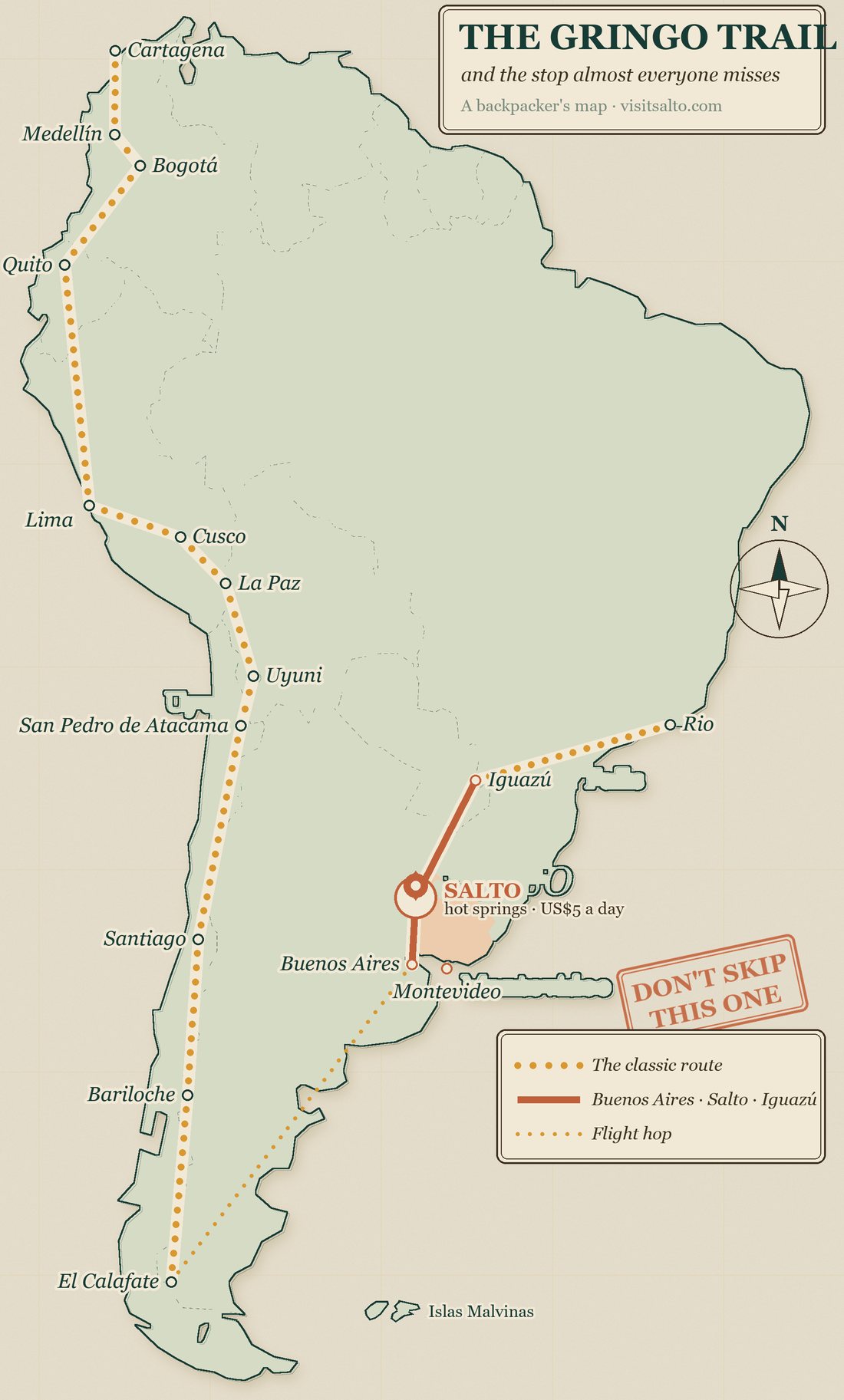
You know the route. Down the Andes through Colombia, Ecuador, Peru and Bolivia, across to Chile, south to Patagonia, back up to Buenos Aires, and then the long haul north to Iguazu and Brazil. Somewhere around Buenos Aires the body files a complaint: too many night buses, too much altitude, too many 4 a.m. alarms for a sunrise.
Here is the thing nobody on the Gringo Trail tells you. Between Buenos Aires and Iguazu, a short boat ride across the river from the bus you are already on, there is a small Uruguayan city where you can lie in naturally hot water from eight in the morning until ten at night for about five US dollars. Dorm beds start around US$17. Hostels charge you no VAT because you are foreign. And when you are done, the same road carries on to the falls.
That city is Salto. This is the budget version of the pitch: what it costs, how to get here without wasting a day, and what I would honestly tell a friend with a 40-litre pack.
First, the Map
Salto sits on the Río Uruguay in the north-west of Uruguay, directly opposite the Argentine city of Concordia. Concordia is on the main bus corridor from Buenos Aires up to Iguazu. So the geography does the work for you: bus from Buenos Aires to Concordia, cross the river, soak for two or three days, cross back, carry on north. Or come the other way, from Montevideo, and leave for Argentina by boat. You are not adding a country. You are adding a stop on a road you were taking anyway.
What a Day Actually Costs
Prices below are what I see on the ground in 2026, in US dollars for convenience. Uruguay uses the peso (UYU), and prices move, so treat these as a working budget rather than gospel.
| Item | Roughly | Notes |
|---|---|---|
| Dorm bed | US$17–25 | 0% VAT for foreign passport holders, billed VAT-free at check-in |
| Termas del Daymán, all-day entry | US$5 (UYU 200) | Open daily 8:00–22:00, 11 pools, one ticket for the whole day |
| Locker or towel hire at the park | A few dollars | Bring your own towel and skip it |
| Lunch | US$6–10 | A chivito or a plate from the food stalls inside the park |
| Dinner you cook yourself | US$5–8 | Supermarket meat on the park's own parrilleros (brick BBQ grills), see below |
| City bus to and from the springs | Under US$2 each way | About 20 minutes from the centre |
| A full day, soaked and fed | US$35–45 | Less if you self-cater both meals |
Compare that with a single hour-long spa session almost anywhere in Europe or North America and you see why people who arrive for one night stay for three.
Getting Here Without Losing a Day
- From Buenos Aires, direct overnight bus. Flecha Bus and Coit run straight from Retiro to Salto in 6 to 7 hours. Board in the evening, sleep, wake up in Uruguay with a day ahead of you and no hostel night to pay for.
- From Buenos Aires via Concordia. Buses leave Retiro for Concordia all day long (Nuevo Expreso, Flecha Bus, Rápido Tata, about 5 to 6 hours, from around US$30). From Concordia you cross the river by taxi over the Salto Grande bridge, or the proper way, by lancha (see below). This is the route to use if you are continuing to Iguazu afterwards.
- From Montevideo. Núñez and Agencia Central run several daily buses from Tres Cruces terminal, 6 hours or so, around US$40–46. Overnight services exist, so the same sleep-on-the-bus trick works.
- Onward to Iguazu. Cross back to Concordia and take the direct bus to Puerto Iguazú: about 13 hours, once a day, from roughly US$55–60. Another overnight, another night's accommodation saved.
Every route, with timetables and booking links, is on the Getting There page.
The Border Crossing You Will Actually Remember
Most people cross between Argentina and Uruguay on a ferry the size of a shopping centre, or on a bus over a bridge. Here you can do it on a small passenger boat that has been running between Salto and Concordia since before the bridge existed. It holds 88 people and is rarely anywhere near full.
The lancha runs Mondays, Wednesdays and Fridays, leaving Salto at 9:00 and 16:00 and Concordia at 9:30 and 16:30. Be at the port half an hour before departure with your passport. Passengers only, but bicycles are allowed, which makes a bike-and-boat day trip to Concordia one of the best cheap days out in the region. Sailings depend on river conditions, so check before you rely on it. I can book it for you, and the full story of the crossing is in my post about the lancha.
Where to Sleep
Honesty first: Salto is not a hostel town. There are a handful, not a strip. You will find them on the usual booking sites, split between the city centre, where the buses arrive and the riverfront is on your doorstep, and Termas del Daymán, where small guesthouses put you a short walk from the park gates. Salto is a year-round destination, so the busy and pricier weeks are not a season but the holiday calendar: Semana de Turismo (Easter week), the July winter school holidays and the long weekends, when families from both sides of the river fill the springs. Book a few days ahead for those. The rest of the year you can more or less turn up.
Whatever you choose, show a foreign passport at check-in and the 22% VAT comes off the bill automatically. No forms, no refund queue at the airport. Details in the FAQ, and more options on the Stay page.
Eating Cheap, Eating Well
- The park has parrilleros (my guide to eating in Salto). Termas del Daymán is a municipal park, and like every Uruguayan park it has parrilleros, the brick grills that asado is cooked on. Buy firewood and a kilo of asado cuts or chorizo at a supermarket and cook your own dinner between soaks. One thing to know: Argentines do their asado fast, over charcoal. Uruguayans do it slowly, over wood, waiting for the logs to burn down to embers and letting the meat take its time. It is less a meal than an afternoon, and it costs a fraction of a restaurant.
- The chivito is Uruguay's national sandwich: steak, ham, cheese, egg, lettuce, tomato and mayonnaise on a bun. One is a meal. Two is a mistake you will make anyway.
- Pay by foreign card. In season, restaurants knock the whole VAT off the bill when you pay with a debit or credit card issued abroad. It adds up over a week.
- Mate is free. Buy a gourd, a bombilla and a bag of yerba in any supermarket, fill your thermos at the hostel, and you have the same afternoon drink as everyone on the riverfront. It also gets you talking to people faster than any hostel bar.
Free Things That Are Worth Your Time
- Sunset on the costanera. Salto faces west across the river, so every evening the sun goes down over Argentina in front of the whole town. The southern waterfront is the classic spot; the northern one, Costanera Norte, is where the football pitches, playgrounds and late-night crowd are. My sunsets post has the best places to sit.
- Lagartear. A local verb that means lying in the winter sun like a lizard, ideally with a bag of locally grown mandarins. It is a legitimate activity here.
- Walk the old port. Plaza Roosevelt, the Palacio Córdoba, the lancha coming and going. Twenty minutes, no ticket.
Worth the Splurge
If you have one indulgence in you before the falls, these are the two I would pick, both bookable directly through me with no agency margin on top:
- Horse riding along the river and into open countryside, US$15 per person per hour, booked by the hour, all year round.
- Discover Scuba Diving in a flooded quarry near the Salto Grande dam, US$60 with all gear, no experience needed. Diving in Uruguay is a genuinely unusual line in a travel diary.
The full list is on the experiences page.
When to Come
Any time. The springs run at 35–40°C every day of the year and Salto has visitors in every month, which is rare on this continent. If you can choose, the best time to be in hot water is when the air is cold: May to September gives you the contrast between a sharp morning and a 40-degree pool that summer cannot. Summer (December to February) is hot, and the river and the sunsets are at their best.
Prices do not follow the seasons. They follow the holidays. The expensive weeks are Semana de Turismo (Easter week), the July winter holidays and the long weekends, when the whole region comes to soak. Outside those, a bed costs much the same in January as in June.
What I Would Tell a Friend
- Salto is not a party town. If you want the hostel-bar circuit, Buenos Aires has it. Come here for the opposite.
- A little Spanish goes a long way. English is less common than on the main trail, and people are patient.
- Two nights is the minimum that makes sense. Three is right. Longer than that happens to a surprising number of people.
- Uruguay is one of the safest countries on the continent, and Salto is a quiet provincial city. Ordinary caution is enough.
“The trail runs right past the door. All you have to do is get off the bus.”
I turned this into a plan. Salto for Backpackers: 3 nights, every item priced — hostel, hot springs, horses, tango and the boat, about US$160 all in, nothing paid in advance.
Questions about routes, the lancha or where to stay? Message me on WhatsApp using the Concierge button, or start with Getting There and Plan Your Trip.