
Words by Mathias Nicola · August 2026 · Revised October 2026
Every evening in Salto, without anyone organising it, the city moves west. Joggers, dog walkers, fishermen, teenagers and grandparents with folding chairs all drift, at more or less the same hour, to the same place: the edge of the city, where the streets end and the Uruguay River begins. They arrive with a flask of hot water under one arm and a mate in the other hand, sit down facing Argentina, and wait for the sky to turn.
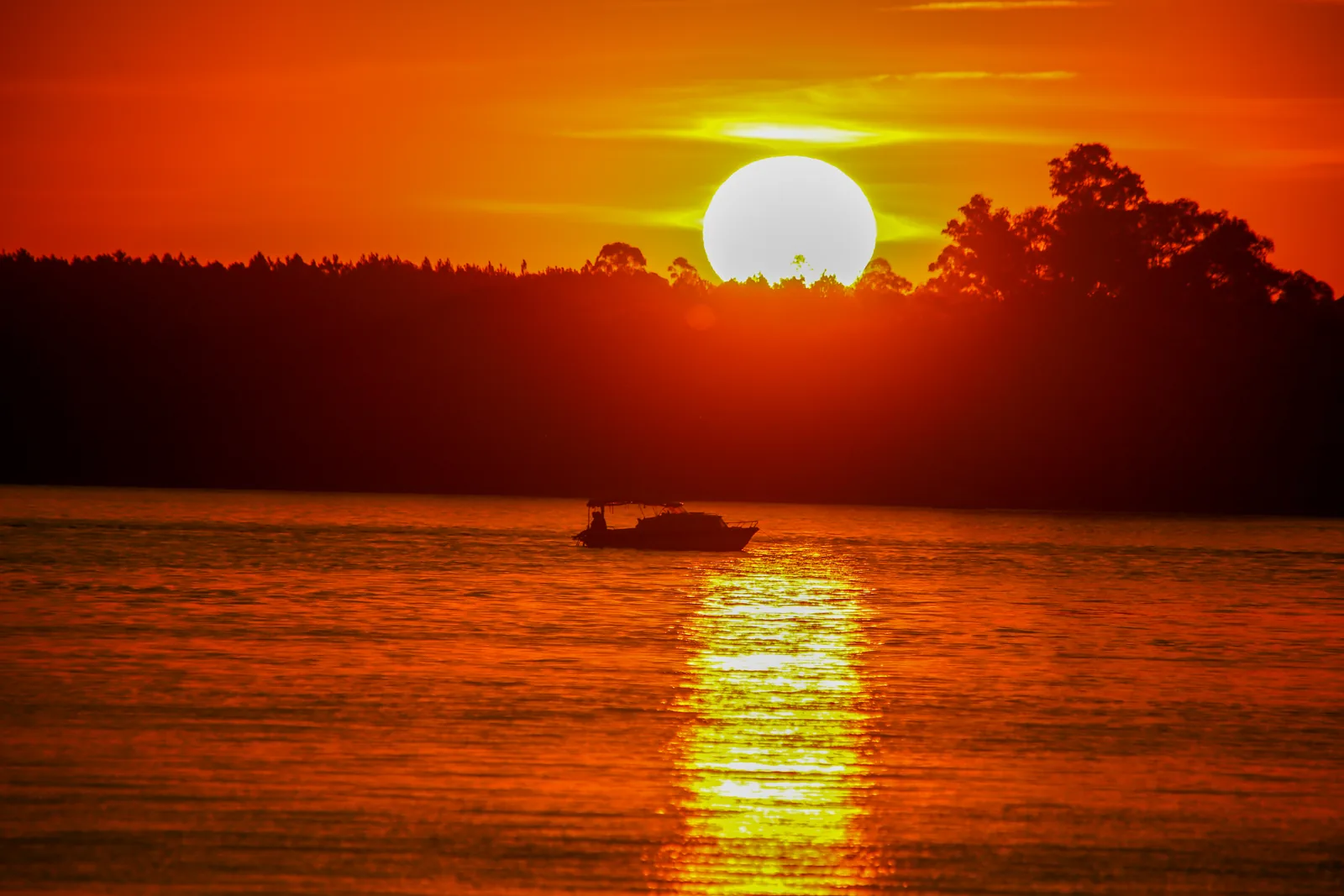
People in Salto will tell you, as a fact rather than an opinion, that these are the best sunsets in Uruguay. Every riverside town says something like it about itself. The difference here is that the geography backs them up, and there are physical reasons for it, which come further down. First, the part you came for: where to sit.
"In Salto the sun sets over another country, and the river brings the colour back to your feet."
Where to Watch It
Costanera Norte. The classic, and the social one. The northern riverfront was remodelled recently and has sports courts, exercise stations, playgrounds and wide paths full of joggers and cyclists, with families spread across the grass. This is where the city goes to end the day: hundreds of people, dozens of mates going round, and the sun going down in front of all of them at once. When the colour fades the evening carries on, because this stretch is also the heart of Salto's nightlife. For a sense of how Salto lives, this is the place.
Costanera Sur and Parque Mattos Netto. Quieter and greener. The southern riverfront runs past Parque Mattos Netto, where a memorial recalls the day in May 1988 when Pope John Paul II came to Salto and said Mass in front of one of the largest crowds in the city's history. It is a fitting place to watch the sky.
Piedra Alta. Further south the bank rises at Piedra Alta, a natural lookout over the water with a monument to Federico García Lorca, the Spanish poet whose strange, persistent link with Salto is a story of its own. A poet's monument facing west over a river at dusk is not a bad place to be.
Plaza Roosevelt and the port. In the centre, Plaza Roosevelt opens onto the river at Salto's old port, with its cranes in silhouette against the evening sky and the Palacio Córdoba, one of the most beautiful buildings in the city, behind you. This is the urban sunset: old architecture at your back, a working river in front, and the 10-minute boat (lancha) to Concordia crossing the view.
The Ayuí and Salto Chico. North of the city the river narrows at Salto Chico, the small falls that gave the city half its name, in the area known as the Ayuí. One of the best buildings in the country for watching a sunset stands here: the Parador Ayuí, designed by Eladio Dieste as a tourist lodge beside the lake of Salto Grande. Its truncated conical roof of reinforced brick (ladrillo armado, Dieste's signature material) is as efficient as it is striking, and the building was declared a National Historic Monument in 2018. The name Ayuí matters in Uruguayan history too: José Artigas's great encampment of the 1811 exodus stood at the Ayuí across the water, and local tradition has him passing north through this river country into his final exile in Paraguay in 1820, never to return. Watching the sun go down here, over the same water, the history does some of the work.
Parque del Lago. Still the Uruguay River, just north of the dam, where it widens into the lake of Salto Grande. The water is broader and stiller than downstream, and on a windless evening it becomes a mirror: the sky burns once above the far shore and again at your feet.
The Ritual
What makes Salto's sunsets memorable is not only the sky. It is what happens underneath it. Sunset here has its own routine: the mate, prepared and passed in slow circles on the grass; the flask wedged upright against a backpack; and, when someone has thought ahead, tortas fritas, discs of fried dough that Uruguayans traditionally make on rainy days, which makes eating them under a clear burning sky feel like a small act of rebellion.
Around you, fishermen tend their hand lines (aparejos, the traditional way here, with no rod) at the water's edge; herons and cormorants fly low along the river on their way home; joggers slow down, almost without meaning to, as the colour peaks. Nobody applauds when the sun disappears. But there is always a pause, a few seconds when the conversations stop, before the city turns and walks home in the blue hour.
On the Water
The connoisseur's version is to watch it from the river. Evening is when the agua planchada arrives, the ironed water: the wind drops, the surface goes flat, and a kayak, a paddleboard or a chalana, the flat-bottomed boat of the local fishermen, glides out onto what looks like polished metal. From the water you get the sunset twice, plus a view the shore never gives you: Salto itself, glowing amber, its waterfront lit from the side. The lake above the dam offers the same in a bigger frame, with sailing, kayaking and watersports and the whole western sky to yourself.
· · ·
Why the West Matters
Here is the thing most visitors never think about: Uruguay faces the wrong way for sunsets. Its famous coast, Montevideo, Punta del Este and Rocha, looks south and east over the Río de la Plata and the Atlantic. Those beaches get fine sunrises, but in the evening the sun goes down behind the land, behind buildings and hills, and the sea turns grey before the sky does.
Salto is the mirror image. The city sits on the east bank of the Uruguay River, so its whole waterfront looks due west, straight at the setting sun. Between you and the horizon there is 1 km of open water and then the low, flat line of Entre Ríos, Argentina. No towers, no headlands, nothing in the way. The sun sinks over another country while its light travels back across the river to the Uruguayan shore. It is one of the very few places in the country where the day ends over water, and that, more than anything, is what the reputation for the best sunsets in Uruguay is built on.
Is There Science Behind the Claim?
Honestly: no laboratory has ranked the sunsets of Uruguay, and no paper crowns Salto. "The best" is a claim of love, not of measurement. But the physics of what makes any sunset spectacular is well understood, and Salto ticks almost every box.
The long path of light. At midday, sunlight comes through the atmosphere almost vertically. At sunset it arrives at a low angle and travels through many times more air. Along that longer path the short blue wavelengths are scattered away (Rayleigh scattering), and the long reds, oranges and golds are what reach your eye. This happens everywhere on Earth. What differs is how much of the show you get to see.
A flat, open horizon. The most dramatic colour comes in the last few degrees above the horizon, exactly the part that hills, forests and buildings usually cut off. Salto's water horizon is flat and clear, so the whole sequence plays out to the last sliver of sun and carries on afterwards as the afterglow climbs the clouds.
Clean air. A persistent myth says pollution makes sunsets redder. The opposite is true: haze mutes and muddies the colour, and clean air gives the most vivid skies. The air over the Uruguayan litoral, rural and far from any industry, is about as clean as inhabited air gets, especially after a cold front has rinsed the atmosphere.
Clouds as screens. A cloudless sunset is a gradient. A great sunset needs mid- and high-level clouds to catch the light from below after the sun has gone. Salto's humid subtropical climate produces exactly these: towering summer storm clouds over Entre Ríos that turn violet and orange, and winter skies streaked with high cirrus that go pink for half an hour.
The mirror. Finally, the river doubles everything. On calm evenings the water goes so still that people here have a phrase for it, agua planchada, ironed water, and the whole sky repeats at your feet. Whatever the atmosphere paints, the Uruguay River paints twice.
So, is there science behind the boast? Put it this way: a city designed from scratch for watching sunsets would have a west-facing shore, a wide flat water horizon, clean rural air, a climate that makes photogenic clouds, and a river calm enough to mirror it all. That is Salto.
Practical Notes
The sun sets over the Argentine shore all year: a little after 5.30pm in midwinter and close to 8pm at the height of summer, with no daylight-saving change to complicate things, because Uruguay abolished it. It pays to be there 30 minutes early: the best light often comes before the sun touches the horizon, and the afterglow can outshine the sunset for 20 minutes after it has gone. Winter evenings, especially the day after a cold front, give the cleanest, reddest skies; summer brings storm clouds over Entre Ríos, lit from inside. Winter afternoons have a ritual of their own: sitting in the low sun peeling mandarins from the groves around the city while the light turns gold. People in Salto have a verb for it, lagartear, to lizard, the art of basking in winter sunshine, and the riverbank is the place to practise it. Photographers might look behind them too: in the east, the pink band of the Belt of Venus rises over the city as the sun goes down. And a mate is part of it. Watching a Salto sunset without one is possible, but nobody here would quite understand why.